Teaching · Quantum optics
Photon-atom coupling: one interaction, five levels of description
M1 Photonics Engineering · OIVM master
The whole course hangs on a single term, the electric-dipole interaction −d·E, treated with increasing sophistication. We start from the classical Lorentz oscillator and distil it into the two-level atom; we follow its coherent dynamics, then add dissipation, then recover transition rates as the incoherent limit; we quantize the field to obtain spontaneous emission, let the field propagate, engineer the vacuum inside a cavity, and finally pass from one atom to the optical response of a solid. Coherent dynamics is deliberately placed before the rate picture: it splits the difficulty into two gentle steps.
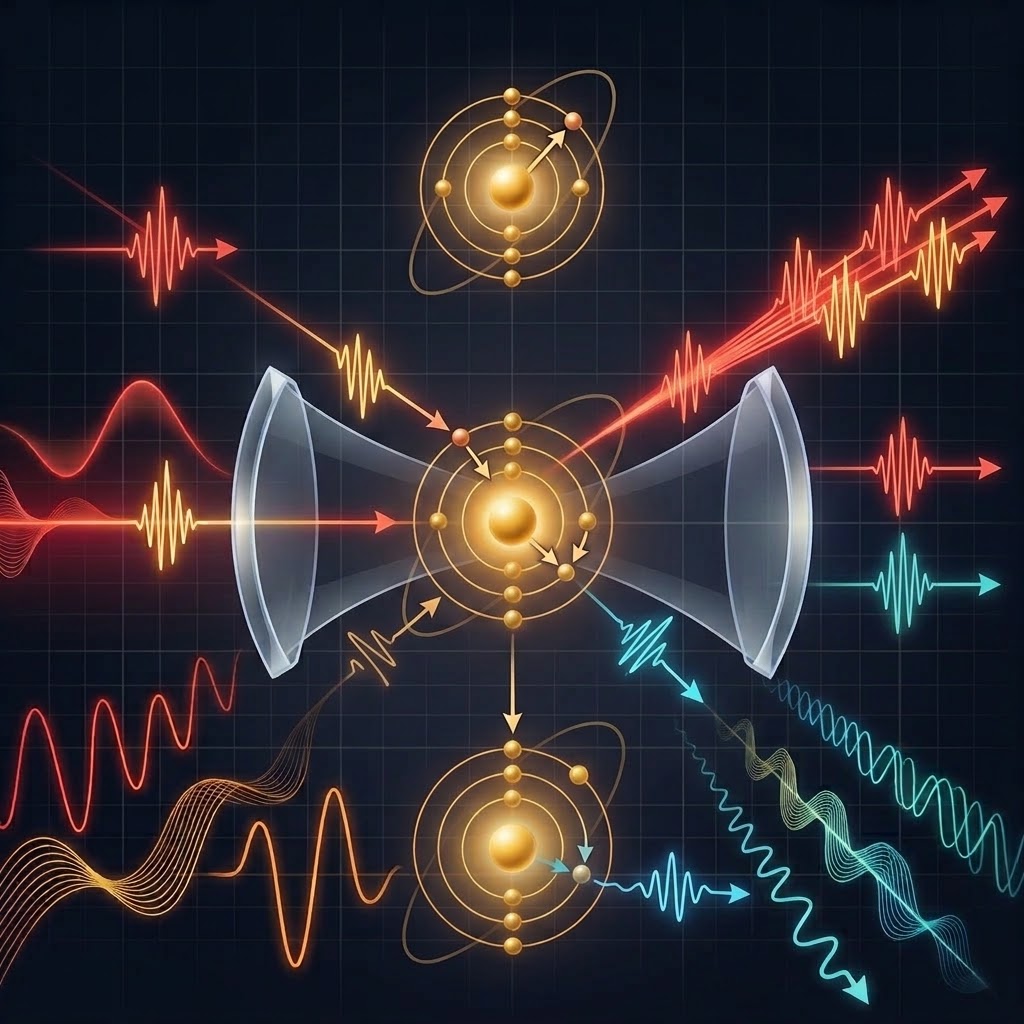
One atom, one mode, one coupling term: absorption, stimulated emission and spontaneous emission all follow from it.
14 h lectures · 16 h problem classes · Semester 1, M1 Photonics Engineering track of the OIVM master · Course material in English
01What the student takes away
The stated aim of the notes is that no formula ever needs to be memorised, because every one of them has been derived in front of the student. Each chapter opens by saying what breaks in the previous description, closes with numerical applications on real systems, and the half-dozen demonstrations that carry the logical chain are written out in full.
02Course outline
- Two ingredients, one question; the quantum turn
- Crisis as method: how physics actually advances
- Models, not mirrors; quantizing the field
- One elementary process, and what is assumed
- The classical benchmark: the Lorentz oscillator
- The atom-field Hamiltonian
- Orders of magnitude
- From the Lorentz oscillator to the two-level atom
- Rabi oscillations and the rotating-wave approximation
- The Bloch sphere: coherent rotations
- Dressed states of a driven atom: the light shift
- The density matrix as a practical tool
- Steady state, saturation and power broadening
- Reversible versus irreversible dephasing: the photon echo
- Time-dependent perturbation theory and the first-order amplitude
- Selection rules: which transitions are allowed
- Absorption, stimulated emission and Einstein coefficients
- Oscillator strength and the sum rule
- Quantizing the electromagnetic field
- Spontaneous emission: the golden rule applied to the vacuum
- Closing the loop between field and medium
- A dilute set of two-level emitters
- Group velocity and slow light
- The Jaynes-Cummings model
- Weak versus strong coupling
- The Purcell factor and its evaluation from cavity parameters
- From atomic levels to energy bands
- From microscopic dipoles to the dielectric function
- Interband absorption via the golden rule
- Excitons: the hydrogen atom inside a crystal
- Polaritons: light-matter hybrids in bulk
- Free carriers: Drude model and metallic reflection
- Microcavity exciton-polaritons: closing the loop with chapter 7
- One coupling, five tools
- Problems with worked solutions
- Mathematical toolbox, constants, stationary states, perturbation theory, second quantisation, formula sheet
03Lecture material
The notes are the reference document and are meant to be read rather than consulted. Colour-coded boxes separate what breaks in the previous theory, the results to remember, the full derivations, the numerical applications, the physical interpretation, and the questions to answer out loud before moving on. The slides follow the same order and are the version used in the lecture room.
04Problem classes
Every exercise is built around a technology that exists today, in a laboratory, a data centre, a hospital or a pocket, and every one of them reduces to the physics of the corresponding chapter. Curves are to be sketched, not just derived: axes, limits, extrema, widths.
The Lorentz model pushed until it produces a technological number, then broken on purpose.
- Rayleigh scattering and the choice of the telecom wavelength: why the loss minimum of silica sits at 1.55 µm and not at 3 µm
- Amplitude and phase of the driven oscillator, applied to terahertz molecular sensing
- The quantum origin of the polarizability: second-order perturbation theory against the classical spring
Rabi physics used as it is used in a real quantum processor and in a real clock.
- From the unitary transformation to the quantum gate, and the crosstalk on a detuned neighbour qubit
- Designing an optical-tweezer array for a neutral-atom quantum computer
- Ramsey fringes and the stability of an optical clock
Relaxation times as engineering parameters rather than as phenomenology.
- Optimising the repetition time of a T1-weighted MRI scan
- Power broadening and the laser lock of a wavemeter
- T1 and T2 read off a qubit datasheet, from the master equation
Where the rate picture is exactly what is needed, and where a forbidden line becomes a resource.
- Photon occupancy, or why lasers exist
- Forbidden lines as a technology: the strontium clock transition
- Can a single atom block a single photon?
Two devices whose performance is set by the spontaneous emission rate alone.
- Efficiency and the colour problem of OLED pixels
- How forbidden is erbium? The transition that runs the internet
The medium sends the field back, and the field notices.
- Open-path methane sensing by laser absorption spectroscopy
- A slow-light delay line for a quantum repeater in Pr3+:Y2SiO5
Changing the vacuum, and reading a qubit without destroying it.
- A telecom single-photon source for quantum key distribution
- Dispersive readout of a superconducting qubit
The single-atom formalism transferred to a screen, a solar cell and a window.
- The colour of a QLED television
- How thick must a solar absorber be?
- Transparent electrodes and low-emissivity windows: Drude engineering
Note
The eight parts are gathered in a single problem booklet, downloadable above. Physical constants used throughout are listed in appendix B of the notes.

