Research
Coherence horizons
Order and disorder at four scales, under a single pulse of light
A femtosecond pulse triggers, inside one volume and in cascade, four order-disorder transitions: the localization of electrons, crystallization within a glass, recrystallization of grains, and self-organization of the surface relief. Each can be run in either direction depending on the irradiation: light destroys one order as readily as it creates another. These four phenomena belong today to four communities that barely speak to one another. The working hypothesis of this research is that they are four realizations of a single far-from-equilibrium problem, and that the same modelling chain can be used to look for their common laws.
A second axis crosses the first. At every scale, order is decided between what is settled on the spot and what is settled at a distance: localized d states against delocalized sp states, short-range against long-range order in a glass, local defects against extended orientation in a polycrystal, near-field overheating against surface waves that couple points micrometres apart. That division is what explains the central paradox of the field, patterns whose periodicity is fixed locally yet which stay coherent far beyond the wavelength, the thermal diffusion length and even the beam.
Electrons
Orbital localization d against delocalization sp
Å, as to ps · finite-temperature DFT, TDDFT
Structure
Amorphous network against high-pressure crystal
nm, ps to ns · molecular dynamics coupled to electromagnetism
Microstructure
Melting against recrystallization, defects created and annihilated
10 nm, ns to µs · two-temperature molecular dynamics
Surface
Smooth surface against self-organized patterns
10 to 100 nm, ns · nonlinear hydrodynamics, amplitude equations
01
Electrons · Å · as to ps
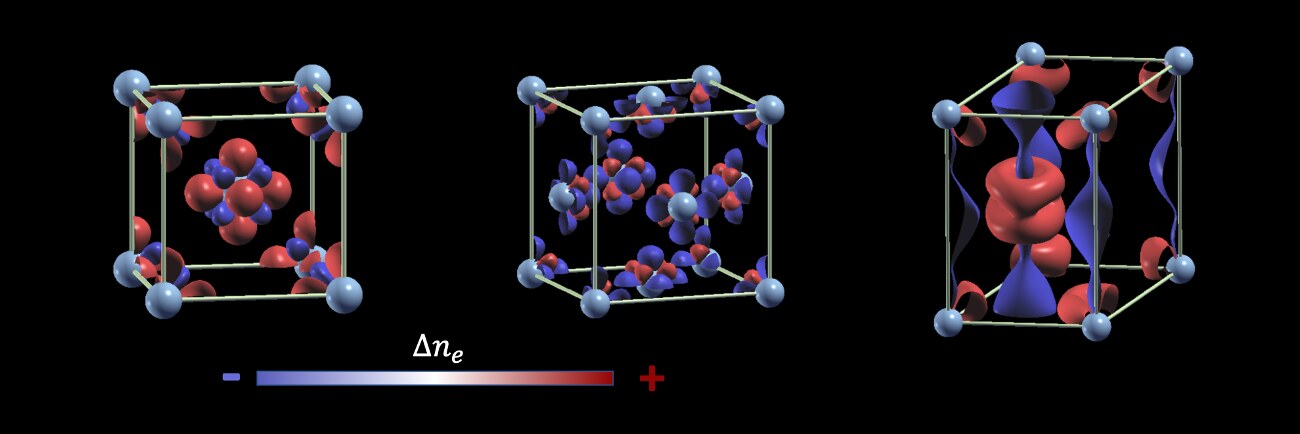
Orbital order under excitation: how a metal reorganizes its electrons
Before any texture, pattern or function can exist, there is this instant when a metal’s electrons are wrenched out of equilibrium. How many remain free? What optical signature does the material now present to light? How strongly does the electron gas speak to the lattice, and beyond what point does the crystal cease to exist as such? Density functional theory answers these questions as functions of a single variable, the electron temperature, and in doing so supplies the common currency that optics, thermal physics and mechanics all draw on, at every scale downstream.
Ab initio calculations with Elena Silaeva, Razvan Stoian, Emile Bévillon, Leïla Ben Mahfoud and Djafar Iabbaden.
Read the theme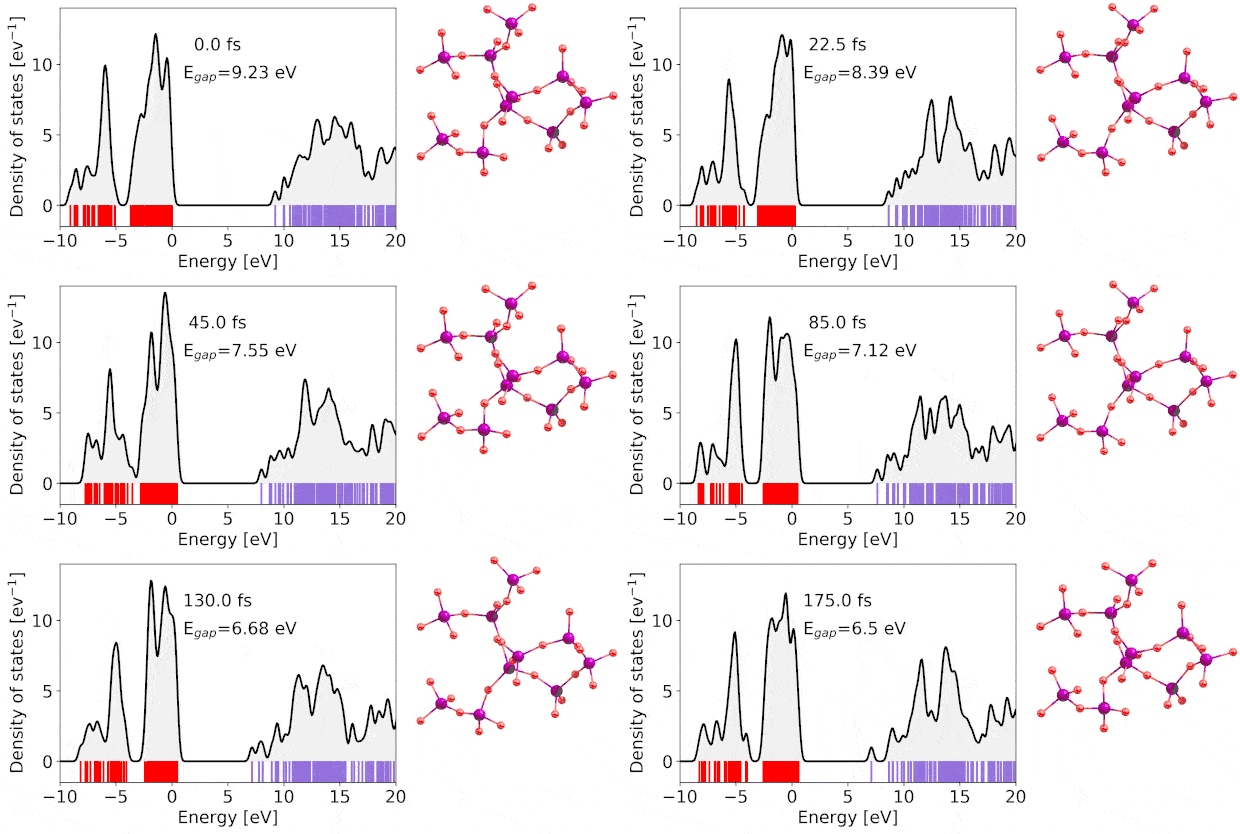
02
Electrons · Å · as to ps
Photoinduced band renormalization in a dielectric: from band-gap narrowing to loss of cohesion
In a wide-gap insulator, excitation does not simply heat electrons that were already free: it brings them into being. The gap narrows, charge deserts the silicon-oxygen bond, and above a threshold the lattice loses its cohesion altogether. Carrier density, heat capacity, electron pressure, effective mass, coupling: the five quantities a two-temperature model needs simply do not exist at equilibrium in a dielectric. They must be computed as functions of the excitation itself, before one can even speak of the material as heated.
First-principles work with Arshak Tsaturyan, Elena Kachan and Razvan Stoian.
Read the theme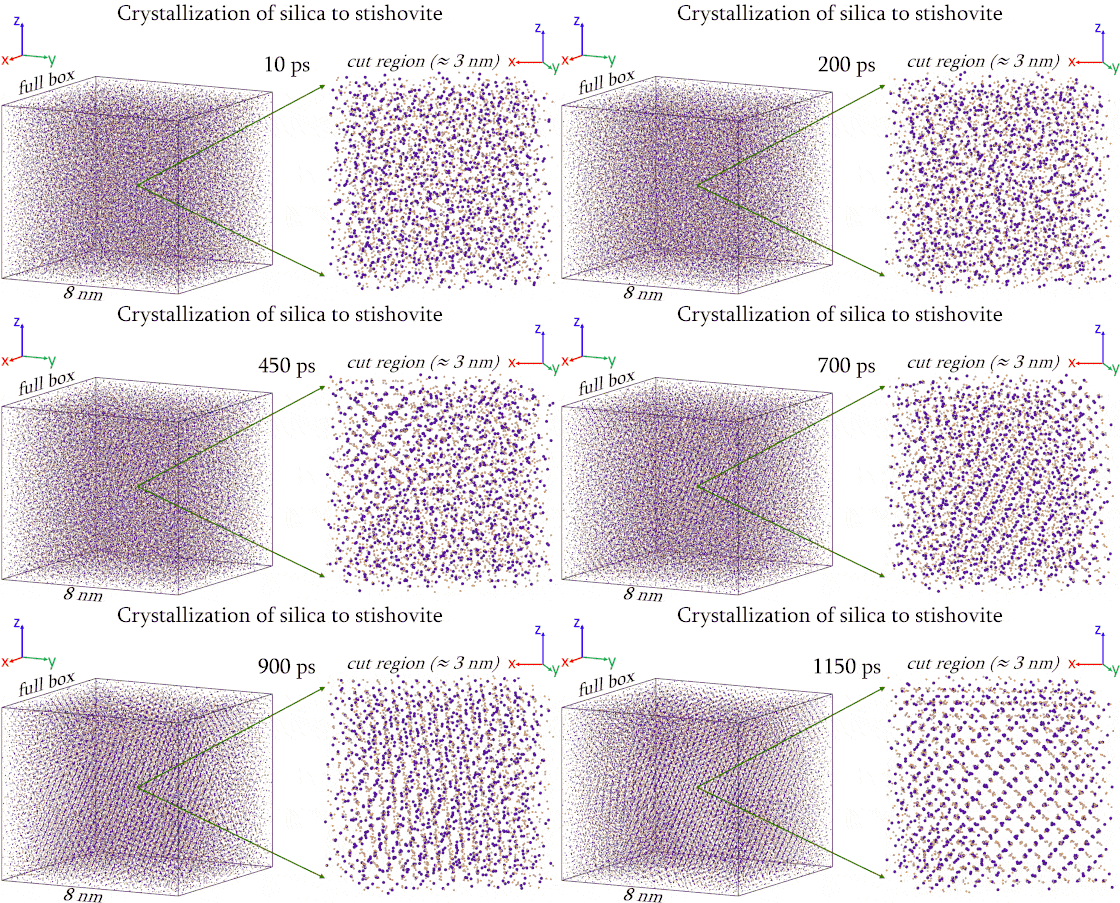
03
Structure · nm · ps to ns
Devitrification: crystalline order nucleating inside a disordered solid
A glass is defined by the very absence of long-range order, and yet a single focused pulse can make a crystal nucleate inside one. Nanopores act as antennas; their collapse leaves, for an instant, a state driven to tens of gigapascals, in which stishovite nucleates fast enough to outrun the pressure’s own relaxation. In a metallic glass, that same race between a rate of transformation and a rate of quenching decides whether the amorphous state survives at all: order and disorder here are less a matter of thermodynamics than of timing.
Multiscale modelling with Aram Yedigaryan, Elena Kachan, Aram Melkonyan and Djafar Iabbaden.
Read the theme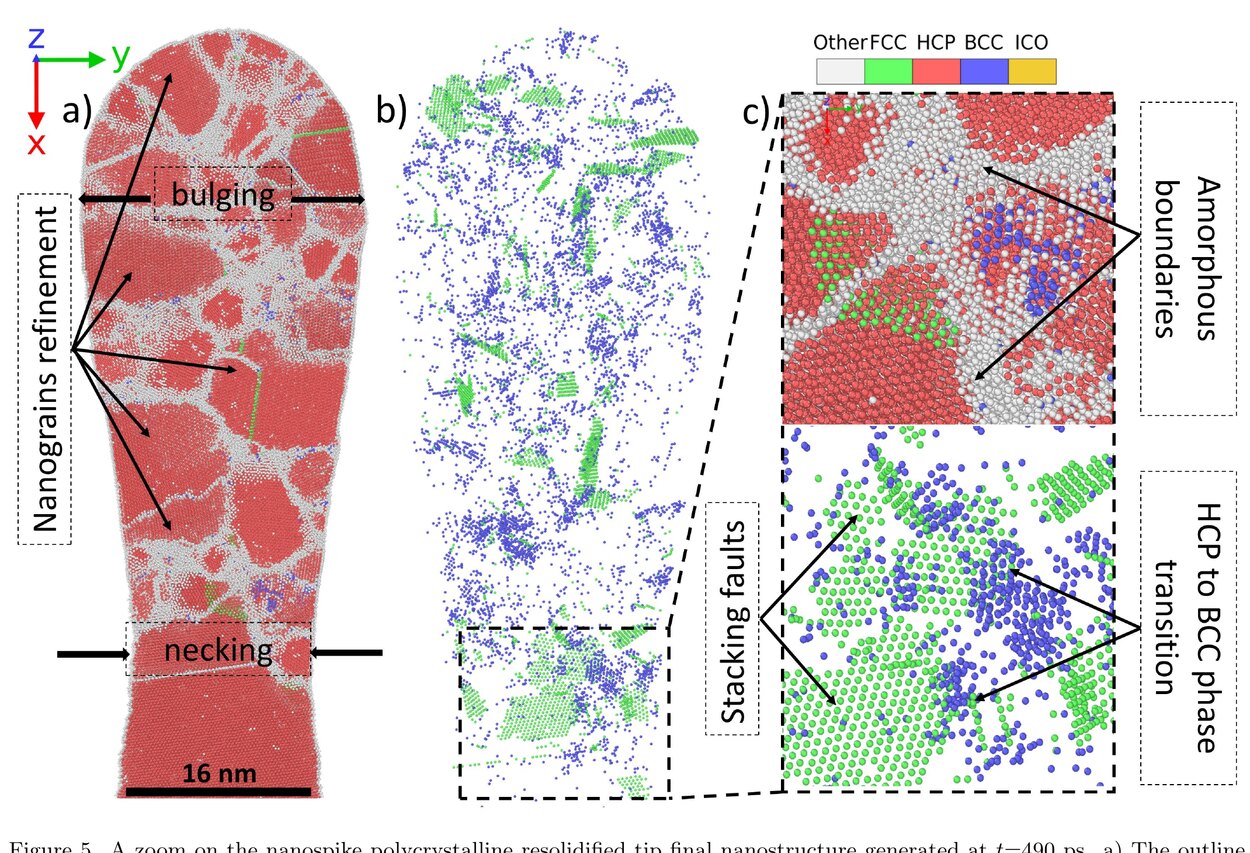
04
Microstructure · 10 nm · ns to µs
Rebuilding the grains: microstructural order reorganized by an ultrafast quench
Melting is instinctively taken for a form of damage. Here, it rebuilds: resolidification does not degrade the grains, it rewrites their architecture, and the new boundaries become amorphous films of trapped liquid. Two-temperature molecular dynamics shows that the outcome is set not by the dose but by the cooling rate: sliding the pulse duration alone across the electron-phonon time multiplies the number of nanograins by four, at strictly the same fluence: matter reshaped by tempo, not by energy.
Atomistic modelling with Djafar Iabbaden and Arshak Tsaturyan.
Read the theme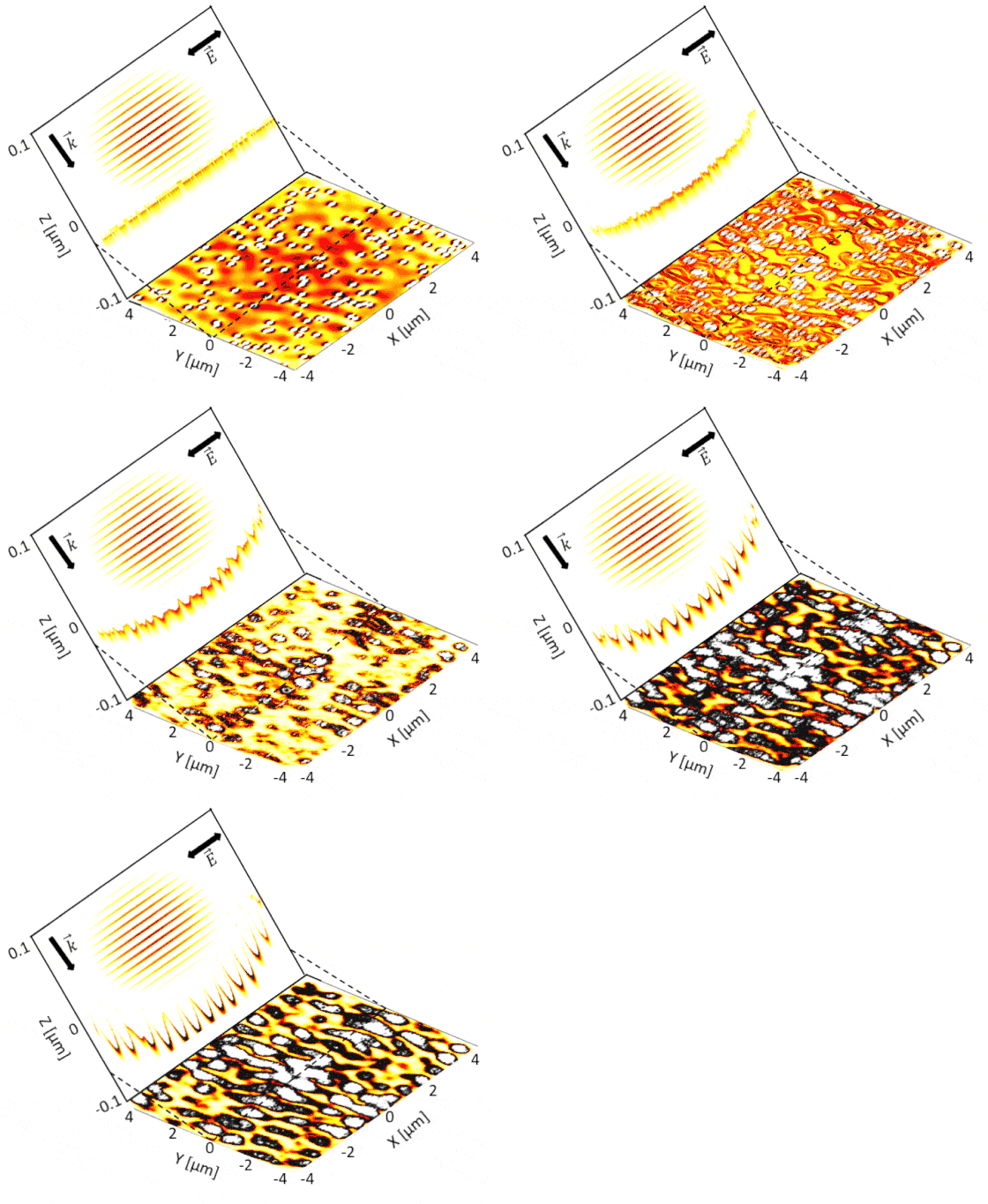
05
Surface · 10 to 100 nm · local and non-local
Coherence in the absorbed energy: how a rough surface organizes light into a pattern
An irradiated surface ends up sculpting its own pattern: periodic structures are born from the interference between the incoming light and the light the surface is already scattering: an optical dialogue in which matter responds to what it has just created. Separating the propagating far field from the evanescent near field is the cleanest way to settle the question of local versus non-local; it explains which family of periods appears, why the spacing drifts with the number of pulses, and what structured light can, and cannot, impose on the material.
FDTD modelling with Vladimir Fedorov, Anton Rudenko, Hao Zhang and Razvan Stoian.
Read the theme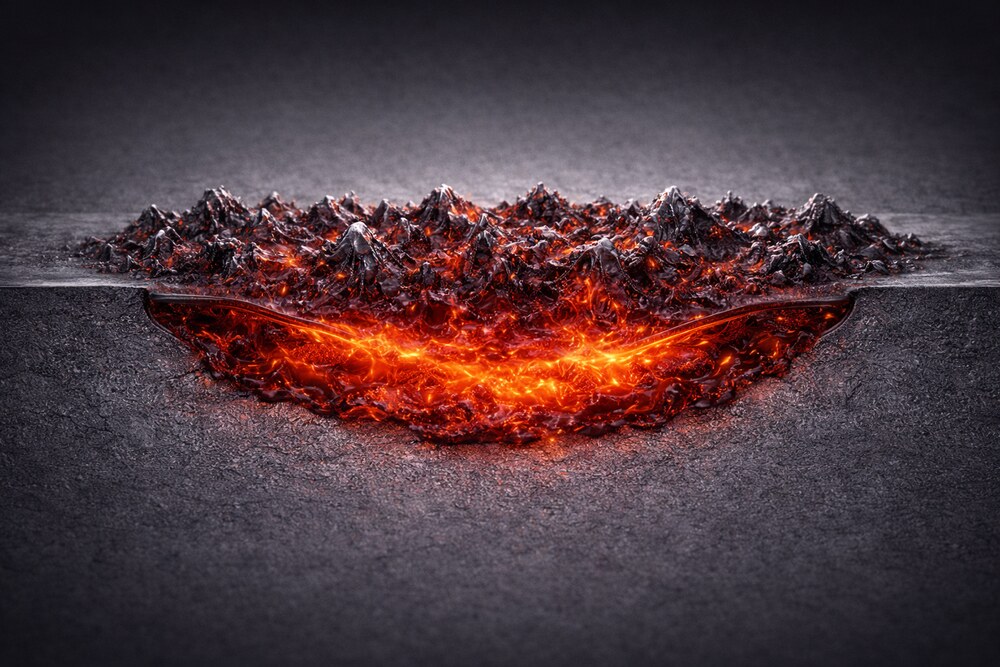
06
Surface · 10 to 100 nm · ns
Laser self-organization of the relief: from a hydrodynamic instability to a selected pattern
Absorbed energy decides where matter heats, never the shape that will appear; that choice is made elsewhere. Across a molten layer only a few tens of nanometres thick, raised by a single laser pulse, thermocapillary convection selects its own wavelength and symmetry, which resolidification simply freezes in place. Reduced to a thin film, this flow obeys the Swift–Hohenberg equation, nature’s generic model of pattern formation: peaks, cavities, stripes and labyrinths all emerge from it with no more than two parameters changed, and machine learning can read the shape alone to recover the fluence and delay that produced it.
Nonlinear hydrodynamics and pattern selection with Eduardo Brandao, Anthony Nakhoul, Anton Rudenko, Emeric Gandon and Quentin Fornasiero.
Read the theme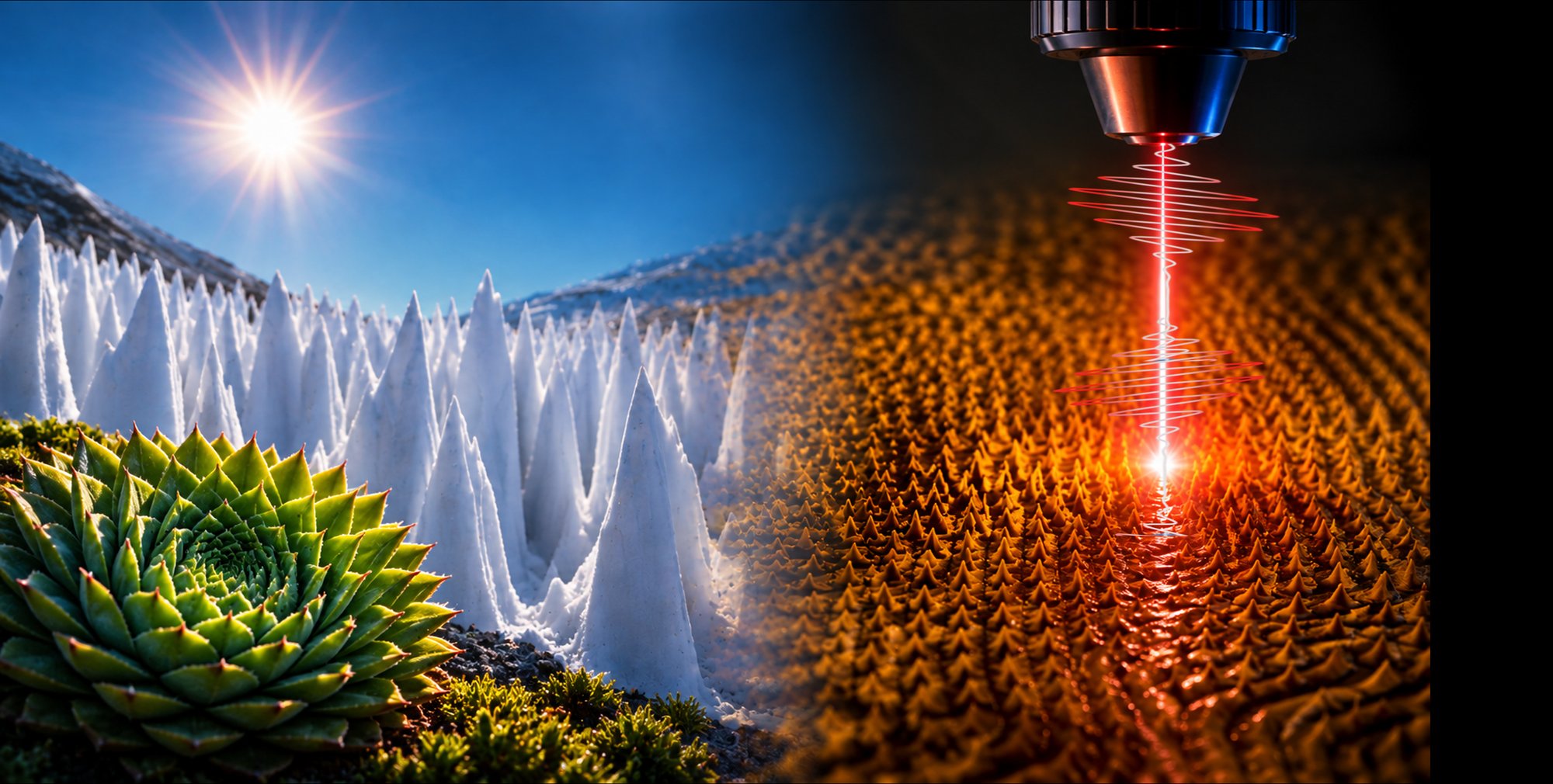
07
Trajectories · tens of pulses · coherence
Learning to absorb light: light organizes, matter remembers
An irradiated surface does not merely erode: it gradually redirects its own way of absorbing light, as though learning from what it has undergone. This capacity to shape a response out of accumulated experience does not appear to be unique to living matter. Here, machine learning serves to reveal that memory of matter, rather than to predict it.
Machine learning and physics with Fayad Ali Banna, Eduardo Brandao, Anthony Nakhoul, Rémi Emonet and Marc Sebban.
Read the theme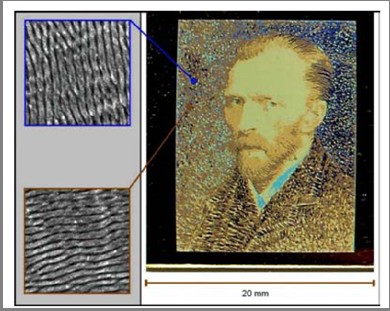
08
Applications · nm to µm · properties
Functionalized surfaces: From organized relief to enhanced functionality
Here, organized relief stops being merely an image and becomes a property. A colour written without a trace of pigment, hydrogen ingress slowed by a periodic texture, topochemistry and nanowells on metallic glasses, controlled oxidation on tungsten, wettability tuned on stainless steel: in every case, function cannot be read off shape alone. Each application therefore sends a question back up the entire chain, closing the loop that runs from the electron to the use.
With Anthony Nakhoul, Mathilde Prudent, Priya Dominic, Djafar Iabbaden, Benjamin Dusser, Florence Garrelie and Jean-François Pierson.
Read the theme
