Research theme 04
Rebuilding the grains: microstructural order reorganized by an ultrafast quench
Scale: 10 nm · ns to µs · order parameter: crystalline orientation and defect density
Between the electrons and the surface relief lies the scale where the metal melts, resolidifies and rebuilds its grains. This is the third of the four order-disorder transitions a single pulse triggers, and the one where the new organization is not inherited from the old: a fraction of the crystal loses its orientation entirely and re-nucleates, so what emerges is a genuinely new grain network whose statistics are set by the quench rather than by the dose.
Hybrid two-temperature molecular dynamics of laser-excited metals and alloys. With Djafar Iabbaden, Arshak Tsaturyan and Jean-Marc Raulot.
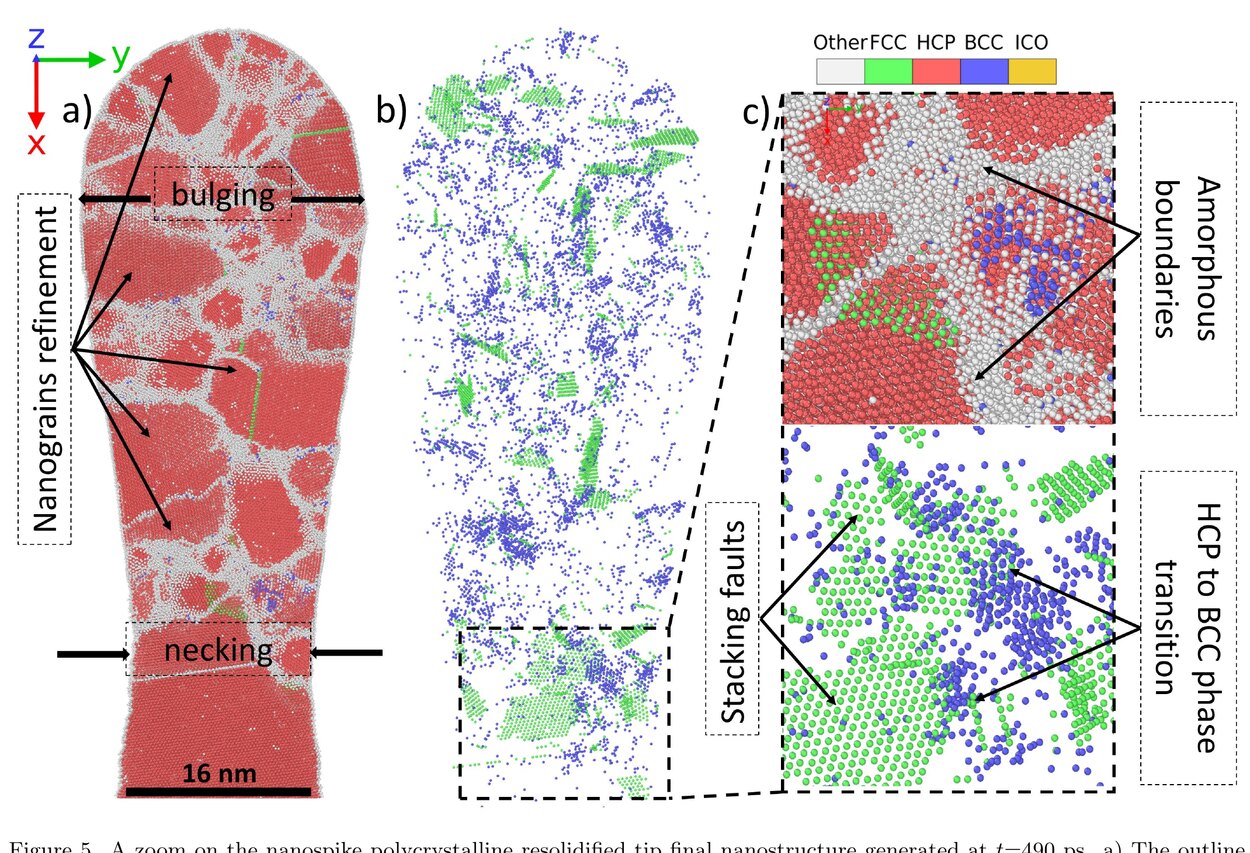
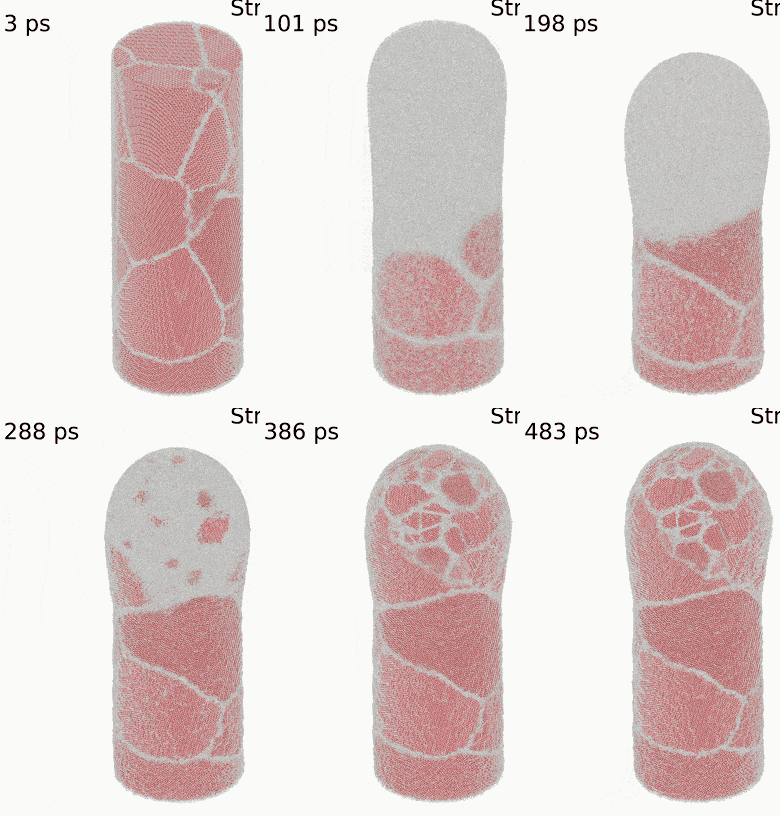
That last detail is the signature of the mechanism. The boundaries between the new grains are not crystalline interfaces inherited from the parent structure: they are amorphous films, frozen liquid trapped between grains that grew towards each other and met too late. The organization visible in this figure was assembled during the resolidification itself, in a few hundred picoseconds, and the shape change happened at the same time.
The method is a coupling rather than a single model. The electron gas is a continuum with its own heat capacity, conductivity and coupling constant, all taken from the first-principles calculations of theme 01. The atoms obey classical dynamics and receive energy through a local friction term. Nothing about melting, nucleation or defect formation is imposed: those emerge from the trajectories.
What this buys is access to the two things a continuum model cannot produce, the crystallographic identity of every atom and the stress field that drives the flow. Grains are then segmented directly from the atomic configuration, which is what makes a grain count a measured quantity rather than an impression.

The hybrid scheme: a continuum equation for the electron gas, Newtonian dynamics for the atoms, and a friction term transferring energy from one to the other cell by cell.
01Organization at the roughness scale: defects first, then nanobumps
In austenitic stainless steel 316L the response splits into two regimes as the fluence rises. At low dose nothing is visible on the surface, yet the crystal is already reorganized: twin boundaries, stacking faults and dislocation networks appear in the recrystallized layer, because the compression and rarefaction waves that follow the deposition leave the lattice distorted as it freezes. The order that is lost here is not the crystal itself but its perfection, and the defect population is a memory of the wave that passed.
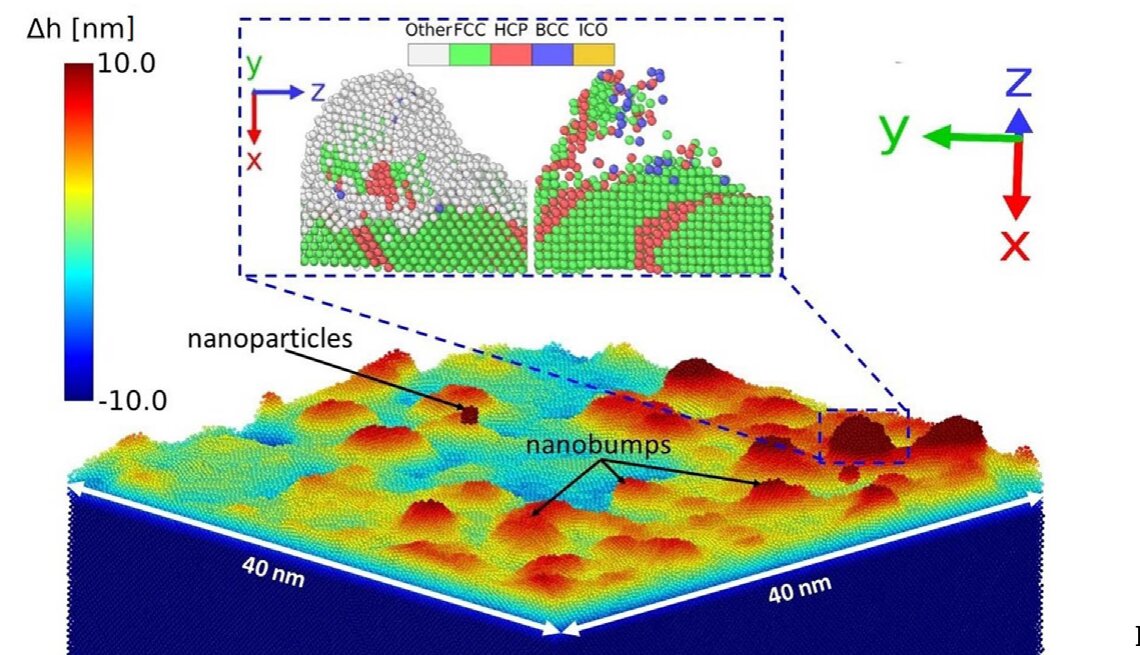
Above a threshold the surface itself starts to move, and an organized relief appears. The nanobumps are not thermal blisters: they are the joint product of the stretching of the liquid layer as it is pulled outwards, the confinement of stress in a layer too thin to relax, and a resolidification fast enough to freeze the shape before capillarity flattens it. The defects left under each bump record the flow that produced it, so the structural and the morphological organizations are two readings of the same event.
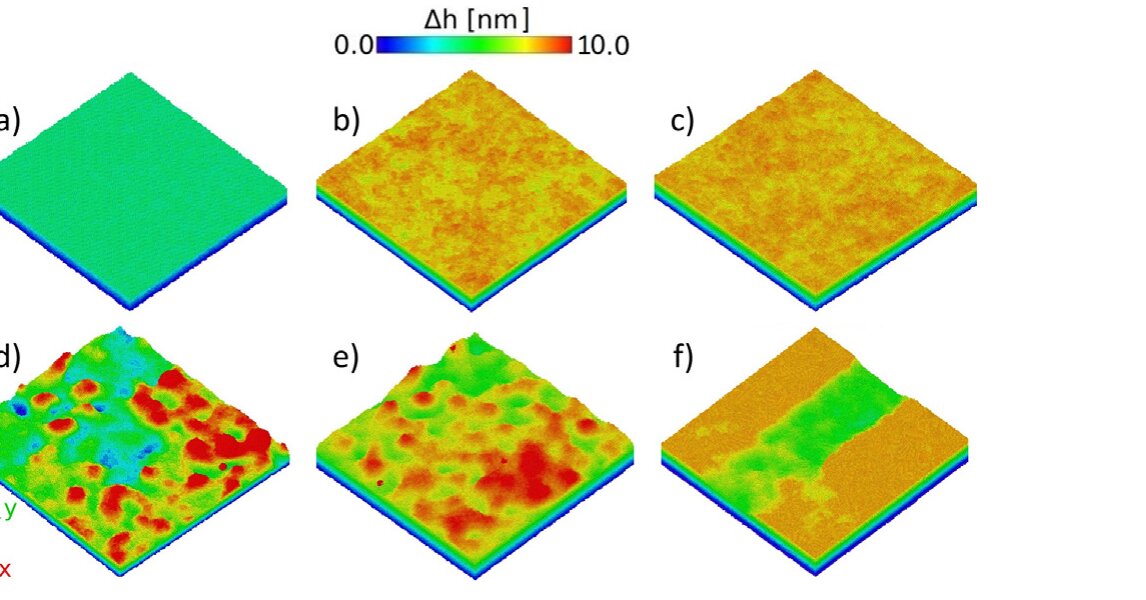
This matters twice over. The relief is what the next pulse will scatter from, which links this scale to the electromagnetic one, and it is also what a liquid will see. A water nanodroplet placed on the simulated surfaces gives a contact angle of 75 degrees on the flat reference, in agreement with the 70 to 77 degrees measured on smooth 316L, and that angle moves with the fluence. The same irradiation that writes the roughness therefore selects the wetting behaviour without changing the chemistry: the first nanometres show no segregation of chromium or nickel.
The organization written at the roughness scale is mechanical and structural, not chemical. A relief and a defect population are enough to move a macroscopic property.
02Organization at the grain scale: two growth modes in competition
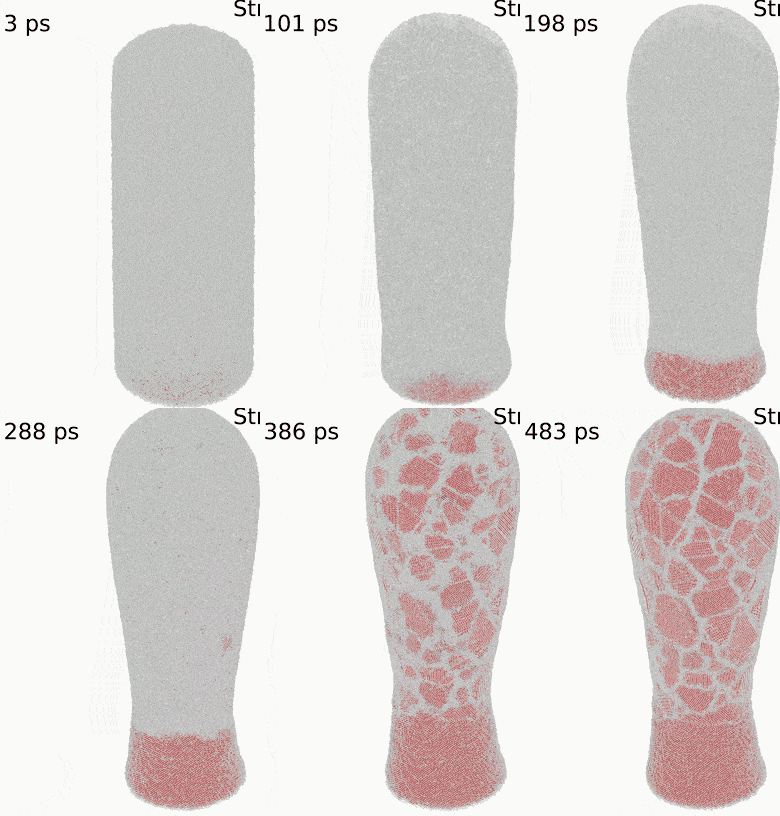
One scale up, the question becomes how a fully melted volume chooses its new grains. In the zirconium nanospike two modes are activated simultaneously and compete. An epitaxial front advances from the cold solid-liquid interface at the base, inheriting the orientation of the grains that survived, so it propagates the old order. Nucleation is triggered independently at the outer shell of the tip, where the liquid touches vacuum and is the most undercooled, and it creates grains with no memory of the parent orientation.
Only the second mode refines, and it is stochastic. Grain segmentation gives nineteen grains before the pulse and a hundred and seventy-five at 490 ps, the initial population fragmenting progressively into a finer distribution. The competition between an ordering front and a disordering shower of nuclei is what fixes the final statistics, and shifting the balance between the two is what the next section does.
03One hundred femtoseconds against five picoseconds
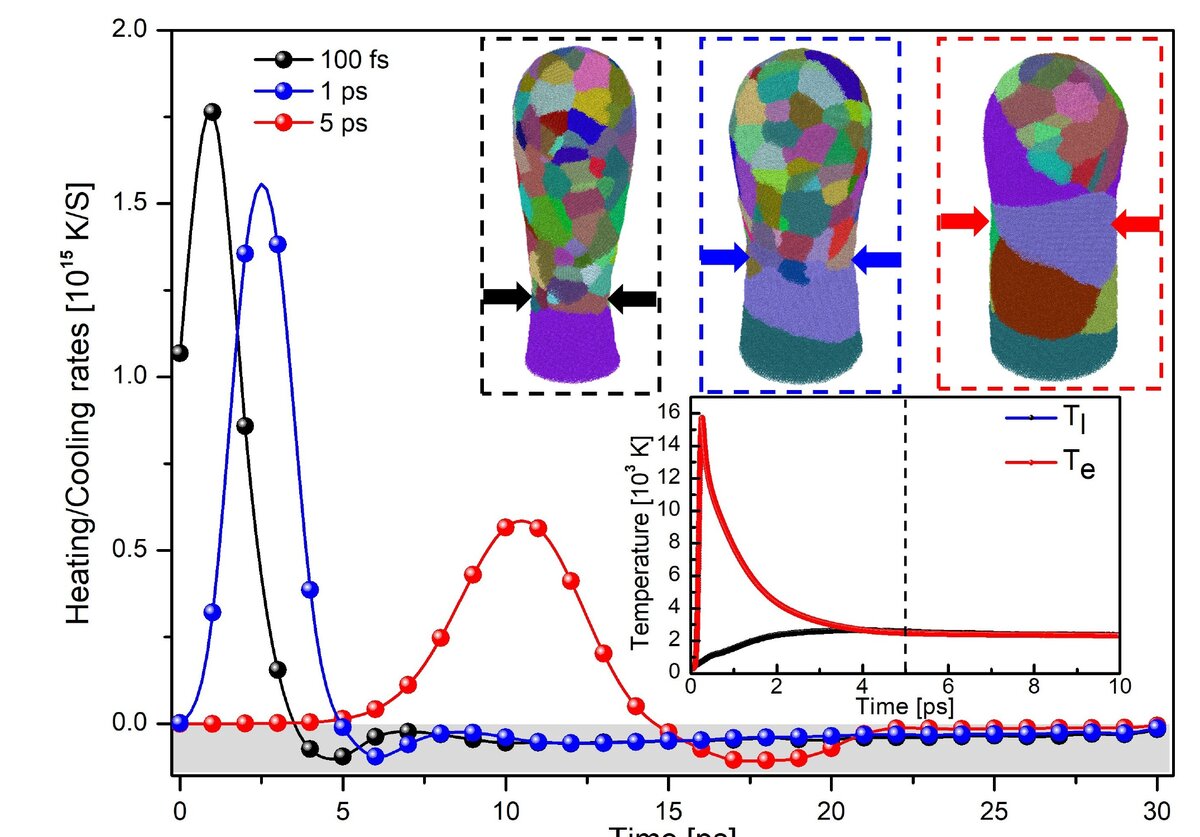
The cleanest way to show that the quench, and not the dose, is in control is to hold the incident fluence at 48 mJ/cm2 and change only the pulse duration. Zirconium has an electron-phonon relaxation time close to 5 ps, so the comparison brackets it: at 100 fs and 1 ps the energy arrives far faster than the lattice can heat, while at 5 ps the transfer happens during the pulse and the two temperatures stay together.
The consequences all point the same way. A short pulse confines the energy, steepens the gradients and drives the liquid deep below its melting point, which multiplies the nucleation sites; a long pulse spreads the deposition, melts thermally and leaves a shallow, extended undercooling. The final grain count follows: one hundred and seventy-five nanograins at 100 fs, one hundred and forty-one at 1 ps, thirty-nine at 5 ps.
The morphology follows the same ordering. A deep undercooling confined to a small region intensifies the capillary flow and produces a sharply bulged and necked tip, while the shallower undercooling of a long pulse barely changes the shape.

Undercooling and quench rate. Below the electron-phonon time the liquid is quenched at 1013 to 1014 K/s and undercools by about 1226 K at 100 fs and 1042 K at 1 ps. At 5 ps the quench falls to 1010 to 1011 K/s and the undercooling to 621 K.
04The model: capillary flow against crystallization
The two observations, a shape that changes and a grain network that refines, are not independent, and the article closes with a reduced model that couples them. The molten cap evolves under a balance between the Laplace pressure that drives the flow and the viscous resistance that opposes it, with the transient stress waves and the axial tension entering as perturbations.

Reduced dynamics of the molten cap radius. The Laplace pressure of about 0.3 GPa drives the flow, the stress waves of about half a gigapascal and the axial tension modulate it, and the effective viscosity sets the pace.
The numbers make the argument. With a surface tension of 1.5 N/m, a cap radius of about 5 nm and a melt depth of about 20 nm, the naive capillary velocity would be around 300 m/s, whereas the simulations show 15 m/s. The discrepancy is not an error: deep undercooling raises the viscosity of liquid zirconium by more than an order of magnitude above its value at the melting point, following an Arrhenius law, and the effective viscosity near 1000 K reaches about 0.1 Pa s.
This gives a viscous relaxation time of roughly 330 ps, which matches the few hundred picoseconds over which the bulging and necking develops in the simulations. The shape has time to evolve, but only just, before crystallization arrests it.
One check justifies the whole reduction. At these dimensions and timescales the flow is dominated by viscous dissipation rather than inertia, which the Ohnesorge number confirms by coming out around two. The molten cap is therefore correctly described by a first-order relaxation rather than by a full inertial hydrodynamic problem, and the single timescale extracted above is meaningful.
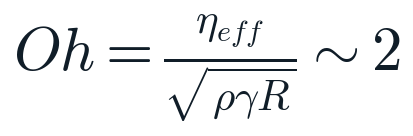
The Ohnesorge number compares viscous dissipation with inertia. Above unity, inertial effects can be dropped, which is what makes the reduced first-order model legitimate here.

Unified diffusion-collision growth velocity. The first term carries the thermally activated diffusive attachment, the second the collision-limited attachment that takes over when the driving force exceeds the thermal energy.
On the crystallization side the same undercooling that slows the flow accelerates the growth. Once the chemical potential difference becomes much larger than the thermal energy, the attachment of atoms at the interface stops being diffusion-limited and becomes collision-limited, and the growth velocity saturates at a value set by the thermal collision rate. With an interatomic spacing of 0.32 nm and an attachment probability of a few percent, the model gives 10 to 20 m/s, which is what the atomistic simulations show directly.
The final structure is then the outcome of a race between two timescales that the pulse duration controls jointly but not identically: the viscous relaxation, which decides the shape, and the nucleation and growth, which decide the grain statistics.
Moving the pulse duration across the electron-phonon time decouples the heating rate from the total dose, and lets one set the depth of the undercooling and the viscous relaxation time separately.
05Where this scale sits in the chain
Upstream, the electron heat capacity and the electron-phonon coupling that drive the two-temperature part are not fitted here: they come from the density functional theory of theme 01, which is what makes the comparison between pulse durations quantitative. Downstream, the relief and the grain structure that survive the quench are the initial condition of the next pulse, both for the electromagnetic problem, since the roughness statistics decide where the energy is absorbed, and for the mechanical one, since the defect population sets how the material responds.
Read alongside the other themes, this is the third rung of the same ladder. An order parameter, here the crystalline orientation and the defect density, is destroyed by the pulse and rebuilt by the quench, and the final state is selected by a competition between a rate of growth and a rate of cooling. The same shape of argument recurs at the electronic, the structural and the surface scales, which is the wager the whole research programme rests on.
Key publications
- Ultrafast laser inducing bulging and nanograin refinement dynamics of polycrystalline nanospikesD. Iabbaden, A. Tsaturyan, J.-P. Colombier, Applied Surface Science 743, 167282 (2026). doi.org/10.1016/j.apsusc.2026.167282
- Atomistic insights into ultrafast laser-induced local structural dynamics and wettability modulation in austenitic stainless steel 316LD. Iabbaden, I. S. Omeje, A. A. Tsaturyan, J.-P. Colombier, Materials & Design 264, 115714 (2026). doi.org/10.1016/j.matdes.2026.115714
- Nonequilibrium electronic properties and stability consequences in metallic crystalline binary alloys under ultrafast laser excitationD. Iabbaden, A. Tsaturyan, J.-M. Raulot, J.-P. Colombier, Journal of Alloys and Compounds 1010, 177175 (2025). doi.org/10.1016/j.jallcom.2024.177175
- Dynamics of Cu-Zr metallic glass devitrification under ultrafast laser excitation revealed by atomistic modelingD. Iabbaden, J. Amodeo, C. Fusco, F. Garrelie, J.-P. Colombier, Acta Materialia 263, 119487 (2024). doi.org/10.1016/j.actamat.2023.119487
- Molecular dynamics simulation of structural evolution in crystalline and amorphous CuZr alloys upon ultrafast laser irradiationD. Iabbaden, J. Amodeo, C. Fusco, F. Garrelie, J.-P. Colombier, Physical Review Materials 6, 126001 (2022). doi.org/10.1103/PhysRevMaterials.6.126001

