Teaching · Modern physics
Special relativity: from a failed experiment to a working accelerator
L3 Physics · Faculté des Sciences et Techniques, UJM
The course starts where the classical picture breaks: Michelson and Morley find no ether wind, Bertozzi accelerates electrons and their speed saturates. Two postulates are enough to repair the damage, but the repair forces every law of physics to be rewritten. We rebuild kinematics, then dynamics, then follow the result into the machines where it is used every day: accelerators, and the collisions they are built to produce.
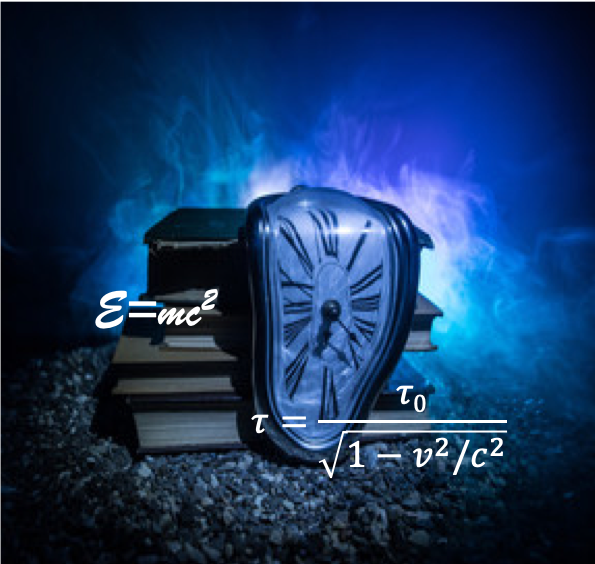
Proper time and rest energy: the two quantities that survive a change of inertial frame.
10 h lectures · 15 h problem classes · 6 h lab work · Third year of the Physics bachelor, Faculté des Sciences et Techniques · Course material in French
01What the student takes away
02Course outline
- The pre-relativistic picture and its problem
- Three experiments: Michelson and Morley, Bertozzi, Sherwood Parker
- The two postulates
- The Lorentz transformation
- Four-vectors
- Consequences: invariant interval, contraction of lengths, dilation of times, causality
- Relativistic kinematics: composition of velocities and of accelerations
- Four-velocity and four-acceleration, tangent inertial frame
- Proper mass and four-momentum
- Fundamental principle of dynamics in relativistic form
- Work of a force, mass energy, rest energy, kinetic energy
- Four useful relations between E, p, β and γ
- Systems of particles, with and without mutual interaction
- Centre-of-mass frame of an isolated system
- Motion in a uniform constant electric field
- Motion in a uniform constant magnetic field
- Limiting cases: momentum parallel or perpendicular to the field
- Energy acquired in an electric field, the electron volt
- Electrostatic accelerators
- Linear accelerators
- Circular accelerators: cyclotron, synchrocyclotron, synchrotron
- Definitions and conservation laws
- Energy balance, or heat of reaction
- Elastic and inelastic collisions and scattering
- Threshold energy of a collision
- Compton effect
03Lecture material
Two sets of slides. The first covers the principles and the kinematics, the second everything that follows once mechanics has been rewritten.
04Problem classes
Four sheets, ordered so that each one uses only what has been derived in the lecture before it. The last two are where the formalism starts paying for itself.
First contact with the transformation, on situations where the classical answer is visibly wrong.
- Two events at the same place in the laboratory frame: separation and relative velocity in a moving frame
- A beam of π+ mesons at 0.99c: can classical mechanics explain the attenuation length?
- Proper volume of a cube seen by a moving observer
The light clock, then an interstellar journey, to make proper time something you compute rather than quote.
- Light clock built from two mirrors: proper period, then period seen from the laboratory frame
- Spacecraft bound for a star 50 light years away: duration on board and on Earth
Energy, momentum and the difference between what a collider and a fixed-target experiment can reach.
- Velocity of a particle whose kinetic energy is K times its rest energy
- Available energy for two protons: head-on collision versus fixed target
- Charged particle entering a constant magnetic field perpendicular to its momentum
Two real machines, sized from the relations established in chapters III and IV.
- Synchrocyclotron delivering 600 MeV protons: extraction radius, number of turns, accelerating frequency at the start and at the end of the cycle
- Proton synchrotron of radius 9 m: injection field, kinetic energy at 1.5 T, relation between radio-frequency and proton energy
05Lab work
Six hours at the keyboard, in Python, with nothing pre-written: the students code the Lorentz transformation itself, then use their own code to look at causality, at the twin paradox and at the decay of a moving particle.
A chronological sequence of events is generated in one frame and transformed into another. The point of the session is that causality is not imposed by hand: it has to survive the transformation the student has written.
- Write lorentz.py, with a transformation_lorentz() function applying a Lorentz transformation to a four-vector
- Plot a set of events in both frames for u/c = 0, 0.1, 0.5, 0.9 and 0.99, over t from 0 to 10 years and −10 < x < 10 light years
- Identify every pair of events whose chronological order is reversed from one frame to the other
- Test the program on x = 0, then on x = ct
- Plot x² − c²t² in both frames and say what it is
- Reverse the direction of the moving frame halfway through the sequence, and simulate the Langevin twin paradox
- Unstable particle of proper lifetime τ0 travelling at 0.8c: draw its decay times from an exponential law and generate the corresponding events
- Transform those events into a frame moving at 0.5c, compare the lifetime measured in each frame and read time dilation off the distribution
Note
Slides, problem sheets and the lab handout are written in French, as taught.

