Research theme 01
Orbital order under excitation: how a metal reorganizes its electrons
Between the arrival of a femtosecond pulse and the moment the lattice starts to heat, a metal spends a picosecond in a state no handbook describes: an electron gas at tens of thousands of kelvin sitting in a cold crystal. Every coefficient used to model laser processing is tabulated at room temperature. This theme computes them where they are actually needed.
Density functional theory of laser-excited metals and alloys. With Emile Bévillon, Elena Silaeva, Leïla Ben Mahfoud, Razvan Stoian and Djafar Iabbaden.
01The material the pulse leaves behind
The pulse does not move the atoms, at least not yet. What it does is redistribute the electrons within the band structure. Imposing that redistribution explicitly, through a Fermi-Dirac occupation at an elevated electron temperature while the ions remain at their equilibrium positions, and recomputing the electronic structure self-consistently, is the whole method.
The result is not a small correction. In transition metals the localized d bands are partially emptied as the temperature rises, which changes the electronic screening and therefore the effective electron-ion potential. The band structure of the excited metal is a different band structure, and it feeds back on the absorption while the pulse is still there.

Occupation imposed on the Kohn-Sham states, with the electron temperature running up to about 105 K while the lattice stays cold.
02How many free electrons does an excited metal have?
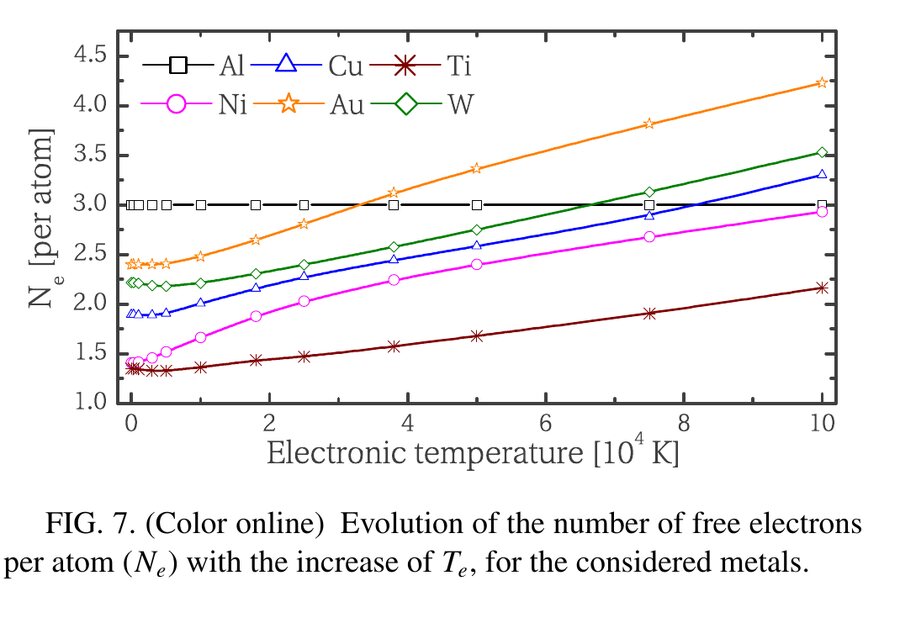
Every classical description of a laser-heated metal, from the Drude permittivity to the transport coefficients, rests on a free-electron number. That parameter is usually taken from the atomic configuration and treated as a constant, which for a transition metal is hard to defend.
A cleaner definition follows from the density of states itself: separate the localized d block from the delocalized sp states, identified by their square-root shape, and count only the delocalized ones, weighted by the occupation.
The parameter that every model treats as a material constant then varies by a factor of two over the range of excitation that laser nanostructuring actually uses. The same shift propagates to the chemical potential, the electronic heat capacity and the electronic pressure.

Free electrons per atom, from the delocalized part of the density of states weighted by the Fermi-Dirac distribution.
Watching the density of states reshape itself as the electron temperature climbs makes this mechanism directly visible: in nickel the d-band edge retreats and the Fermi level drifts noticeably, while in tungsten (already close to a filled, more rigid d-band) the redistribution is far weaker. This contrast in how electrons relocalize across the band structure is the microscopic root of everything that follows on this page: the shifted optical constants, the softened phonons, and the directional loss of lattice stability.
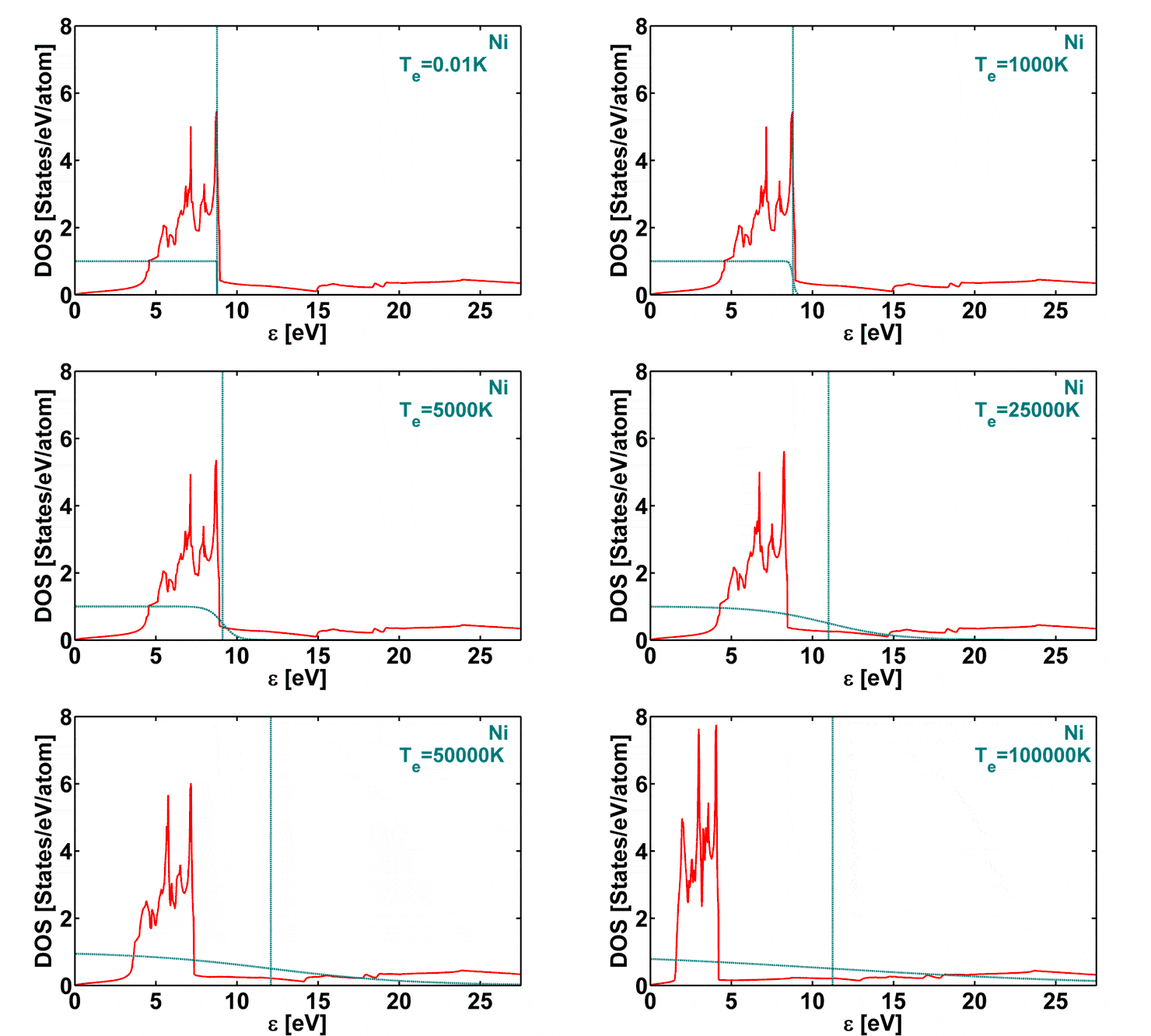
Nickel. The d-band empties and the Fermi level moves as electrons redistribute across the density of states.
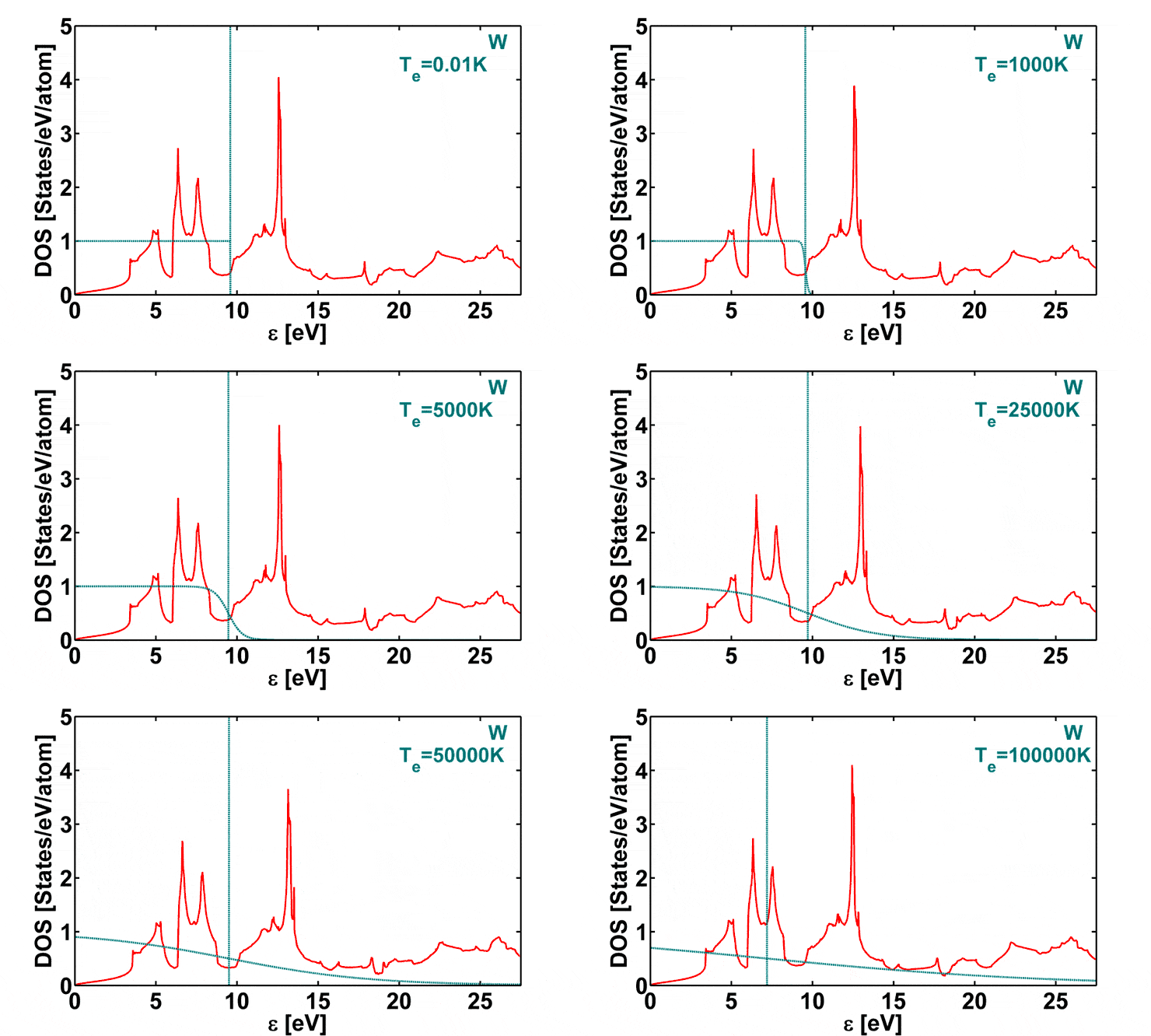
Tungsten. A more rigid, half-filled d-band responds far more weakly to the same heating.
03Heat capacity, and where the energy is stored
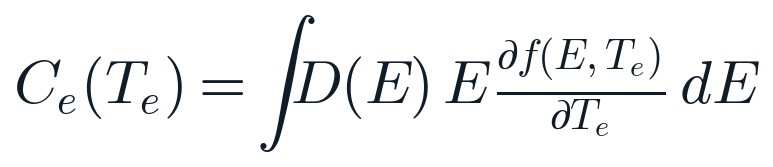
Electronic heat capacity computed from the temperature-dependent density of states rather than assumed linear.
The heat capacity of the electron gas sets how much energy it can hold before returning it to the lattice, and it departs strongly from the linear law of the free-electron model in metals with a partially filled d block. Computing it from the excited density of states rather than fitting it is what makes a two-temperature description transferable from one metal to the next.
04A non-plasmonic metal, briefly made plasmonic
This distinction carries a direct consequence for surface nanostructuring. Tungsten at visible frequencies does not satisfy the condition for surface plasmon propagation: its d-band pseudogap accommodates the chemical potential and produces a quasi-resonant optical behaviour, with the wrong relation between the real and imaginary parts of the index.
Heating the carriers changes this balance. First-principles molecular dynamics combined with the Kubo-Greenwood formalism shows that the d electrons are mobilized into inter and intraband transitions, and that the imaginary part of the optical conductivity flips sign. For a brief window the material becomes plasmonic, a transient state confirmed by time-resolved ellipsometry.
The spectral domain in which surface plasmons can exist, and therefore be invoked to explain self-organized nanostructures, is considerably wider than the equilibrium optical constants suggest.
05The optical constants during the pulse
The dielectric response of the excited electron gas is computed directly from the Kohn-Sham states, without assuming a Drude form. What emerges is a progressive suppression of the interband contribution as the electrons are thermally excited, controlled by the degree of filling of the d block.

Kubo-Greenwood conductivity. The occupation difference carries the electron temperature, so the whole spectrum shifts as the gas heats.
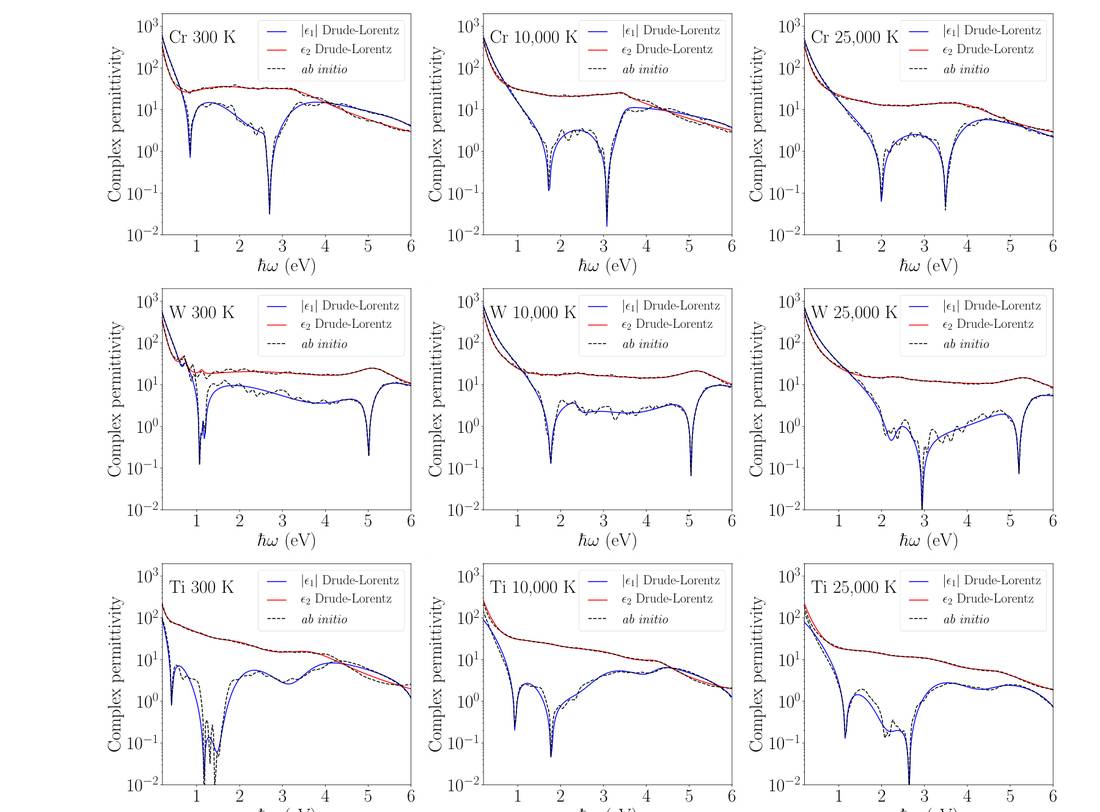
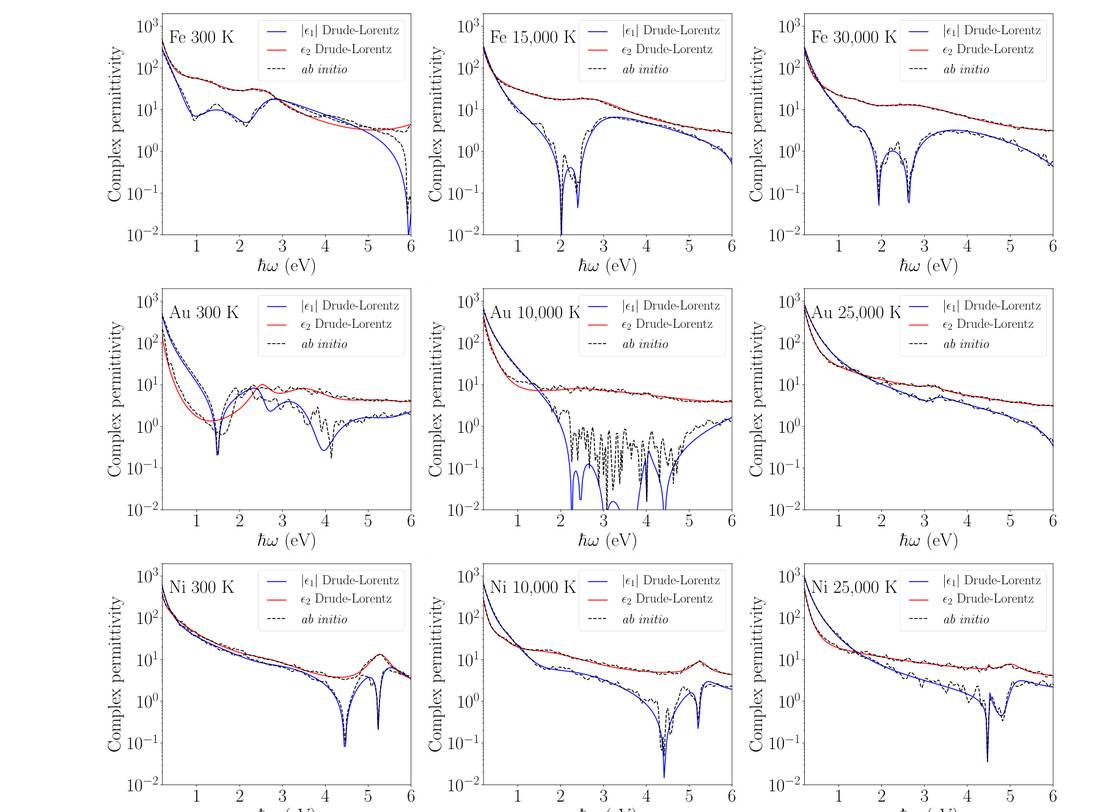

Drude-Lorentz form fitted to the ab initio permittivity, ready to drop into an FDTD or hydrodynamic code.
For propagation codes and two-temperature simulations that require these numbers directly, the ab initio permittivity has been fitted to a Drude-Lorentz form for six transition metals, with electrons heated up to 30 000 K and the lattice at 300 K. The Drude term carries the intraband response, the Lorentz oscillators the interband transitions whose weight collapses as the d block empties.
06How fast do the electrons actually thermalize?
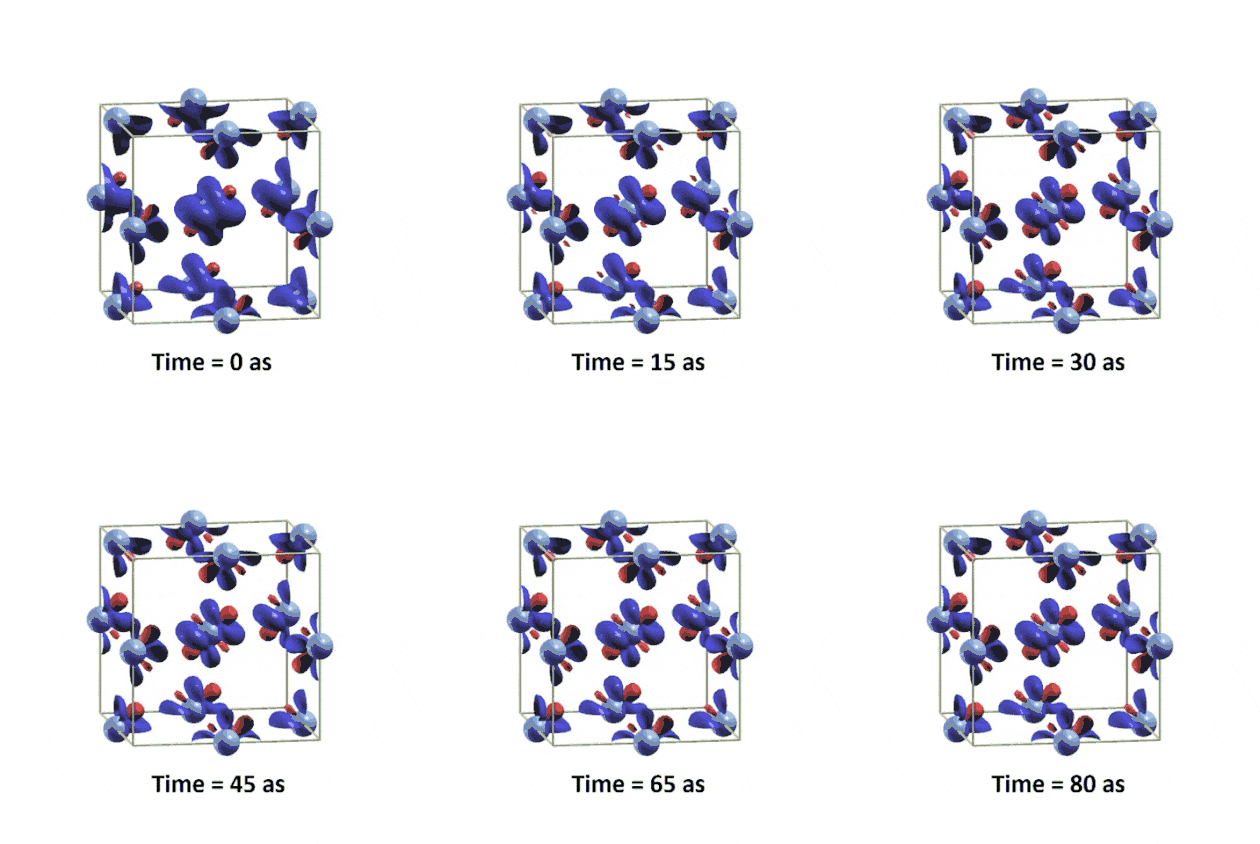
A Fermi-Dirac distribution assumes the electrons have already thermalized among themselves. Whether that is legitimate on the timescale of the pulse is a question in itself, and it is answered by following the excited charge density in real time rather than assuming a temperature. States of different orbital character relax at different rates, which sets a floor on how early a temperature can be invoked at all.
07Talking to the lattice

Electron-phonon coupling built from the density of states and the second moment of the Eliashberg function. It is temperature dependent because the density of states is.
The rate at which the electron gas returns its energy to the ions closes the two-temperature description. It follows from the same first-principles ingredients, and it too varies with excitation.
The chain is then complete on the electronic side: an excited band structure gives the occupation, the occupation gives the thermodynamic and transport coefficients, and those coefficients drive the energy balance that the atoms will eventually feel.

Once heat capacity, conductivity and coupling are computed rather than fitted, the two-temperature model becomes predictive across metals.
08Losing the lattice before melting it
Emptying the bonding states weakens the crystal, and the question becomes whether a solid can lose its stability before it has had time to melt. Following the free energy of chromium, nickel and titanium under electronic excitation gives a surprisingly universal answer: destabilization becomes possible once the electron temperature reaches about 2 eV, whatever the d-band filling and the crystal structure.
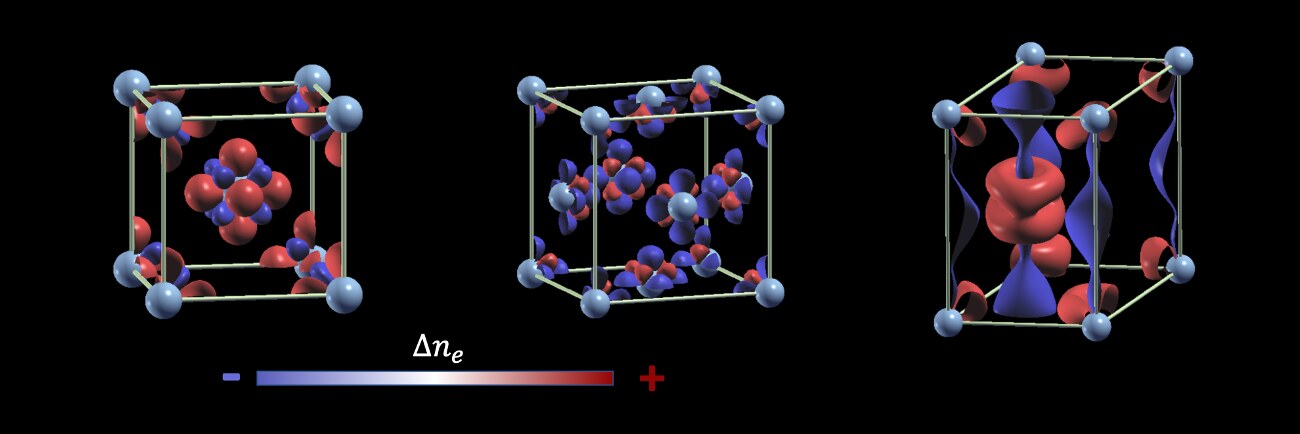
The mechanism is visible in the charge density shown at the top of this page. Hot electrons distort the charge distribution inside a cold lattice and raise the entropy of the system, which drives a mechanical expansion. Under the uniaxial relaxation expected when a surface layer is ablated, that redistribution and the loss of stability orient themselves along specific crystal directions, and the destabilization turns out to be energetically easier in nickel than in chromium or titanium. Nonthermal destructuring is therefore a general feature of partially filled d-band metals rather than a curiosity of one of them.
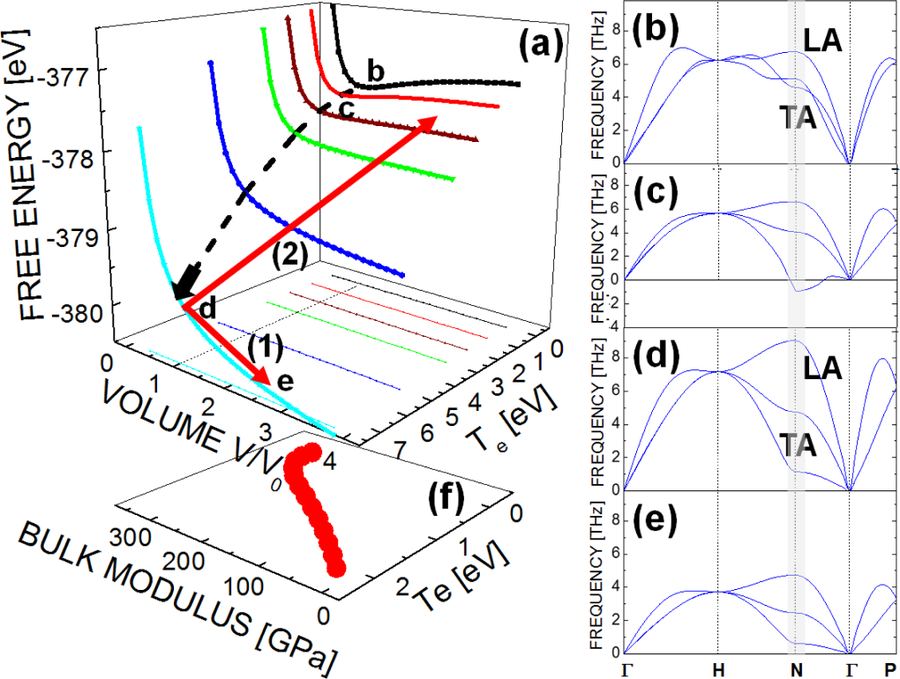
Tungsten stays stiff. Free energy, phonon spectrum and bulk modulus all stiffen with rising electron temperature, consistent with a thermally rather than nonthermally driven destructuring. Zhang, Li, Bévillon, Cheng, Colombier and Stoian, Physical Review B 94, 224103 (2016).
Tungsten offers a clear test of how much this depends on the electron distribution itself. Tracking its free energy, phonon dispersion and bulk modulus as the electron temperature rises reveals a lattice that stiffens rather than softens: the same relocalization across the density of states that empties bonding orbitals in nickel or chromium instead reinforces tungsten’s near-filled d-band, delaying any nonthermal collapse and pointing to a fundamentally thermal destructuring mechanism in that metal.
Nickel shows the opposite response, and its directionality is the signature of the same mechanism working in reverse. As the excited density of states depopulates the bonding d-states, specific phonon branches soften first: the instability does not appear uniformly but along the crystallographic directions where the relocalized charge weakens bonding the most.
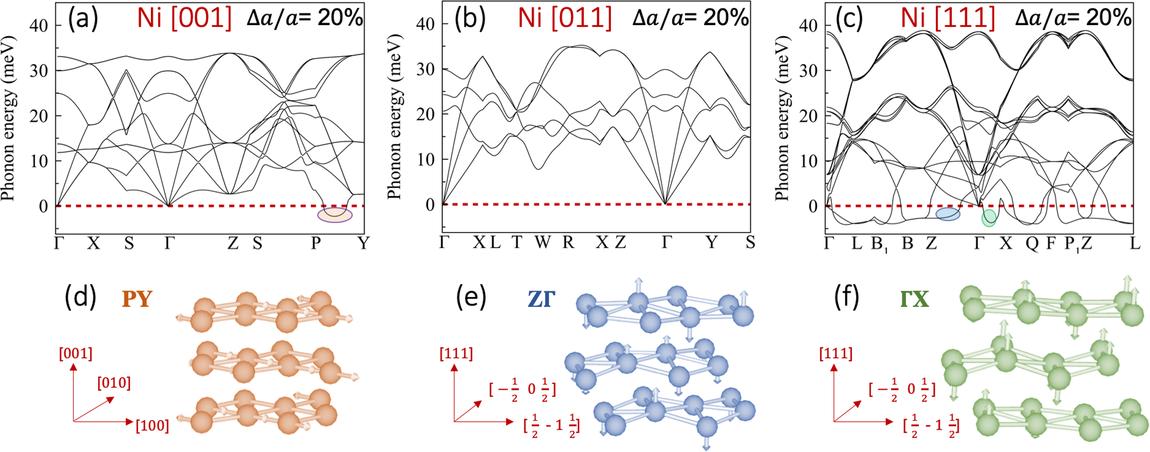
The same reasoning extends to structure and composition. In nickel, comparing the excited face-centred cubic phase with a non-standard hexagonal one shows that electronic heating opens structural relaxation paths closed at equilibrium. For 316L stainless steel the nonequilibrium thermodynamic and transport properties follow the behaviour of the dominant constituent in the same atomic arrangement, and in crystalline binary alloys the excited electronic properties decide whether the structure remains mechanically stable at all.
09Where these numbers go
Two places. The permittivity of the excited metal enters the electromagnetic simulations of absorption on rough surfaces, so the optical problem and the electronic one are not independent: the material the light sees at the end of the pulse is not the one it met at the beginning. The heat capacity, the coupling and the electronic pressure enter the hybrid two-temperature molecular dynamics that follows the atoms through melting and resolidification. A chain of models is only as predictive as the coefficients passed between its links.
Key publications
- Free-electron properties of metals under ultrafast laser-induced electron-phonon nonequilibrium: a first-principles studyE. Bévillon, J.-P. Colombier, V. Recoules, R. Stoian, Physical Review B 89, 115117 (2014). doi.org/10.1103/PhysRevB.89.115117
- First-principles calculations of heat capacities of ultrafast laser-excited electrons in metalsE. Bévillon, J.-P. Colombier, V. Recoules, R. Stoian, Applied Surface Science 336, 79 (2015). doi.org/10.1016/j.apsusc.2014.09.146
- Ab initio nonequilibrium thermodynamic and transport properties of ultrafast laser irradiated 316L stainless steelE. Bévillon, J.-P. Colombier, B. Dutta, R. Stoian, Journal of Physical Chemistry C (2015). doi.org/10.1021/acs.jpcc.5b02085
- First-principles assessment of potential ultrafast laser-induced structural transition in NiE. Bévillon, J.-P. Colombier, R. Stoian, Applied Surface Science 374, 365 (2016). doi.org/10.1016/j.apsusc.2015.12.139
- Ultrafast switching of surface plasmonic conditions in nonplasmonic metalsE. Bévillon, J.-P. Colombier, V. Recoules, H. Zhang, C. Li, R. Stoian, Physical Review B 93, 165416 (2016). doi.org/10.1103/PhysRevB.93.165416
- Ultrafast destructuring of laser-irradiated tungsten: Thermal or nonthermal processH. Zhang, C. Li, E. Bévillon, G. Cheng, J.-P. Colombier, R. Stoian, Physical Review B 94, 224103 (2016). doi.org/10.1103/PhysRevB.94.224103
- Nonequilibrium optical properties of transition metals upon ultrafast electron heatingE. Bévillon, R. Stoian, J.-P. Colombier, Journal of Physics: Condensed Matter 30, 385401 (2018). doi.org/10.1088/1361-648X/aad8e5
- Ultrafast electron dynamics and orbital-dependent thermalization in photoexcited metalsE. Silaeva, E. Bévillon, R. Stoian, J.-P. Colombier, Physical Review B 98, 094306 (2018). doi.org/10.1103/PhysRevB.98.094306
- Structural instability of transition metals upon ultrafast laser irradiationL. Ben Mahfoud, E. P. Silaeva, R. Stoian, J.-P. Colombier, Physical Review B 104, 104104 (2021). doi.org/10.1103/PhysRevB.104.104104
- Drude-Lorentz model for optical properties of photoexcited transition metals under electron-phonon nonequilibriumE. Silaeva, L. Saddier, J.-P. Colombier, Applied Sciences 11, 9902 (2021). doi.org/10.3390/app11219902
- Nonequilibrium electronic properties and stability consequences in metallic crystalline binary alloys under ultrafast laser excitationD. Iabbaden, A. Tsaturyan, J.-M. Raulot, J.-P. Colombier, Journal of Alloys and Compounds 1010, 177175 (2025). doi.org/10.1016/j.jallcom.2024.177175

