Theme 08
Functionalized surfaces: From organized relief to enhanced functionality
A self-organized nanostructure is not an end in itself. The pulse that writes it never writes one thing: it fixes the geometry of the relief, the microstructure of the first few hundred nanometres, and the chemical state of the first few nanometres, all at once. A property reads a combination of those three registers, almost never one alone. This theme is ordered by which register carries the property, from the case where the relief is sufficient to the case where it decides almost nothing.
With Anthony Nakhoul, Mathilde Prudent, Priya Dominic, Djafar Iabbaden, Benjamin Dusser, Noémie Lebrun, Florence Garrelie, Jean-François Pierson, Philippe Steyer, Alixe Dreano and Frédéric Christien.
01Three registers, one pulse
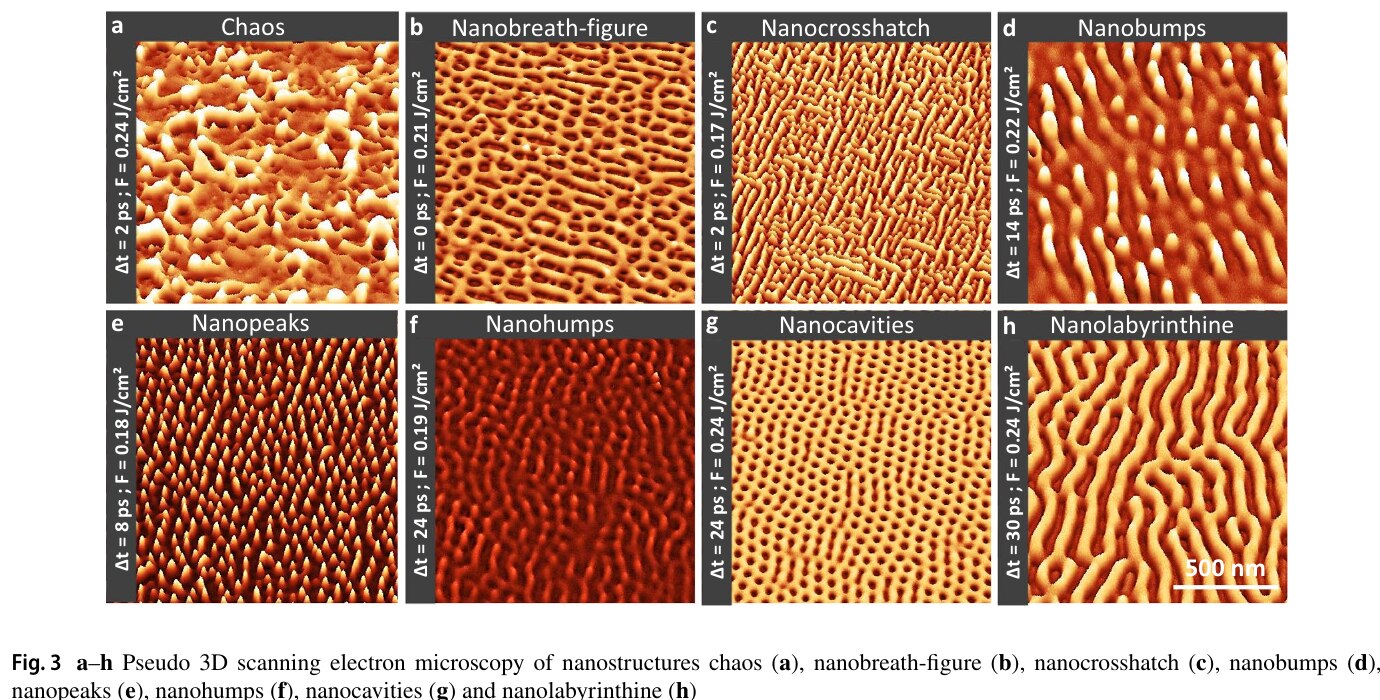
What an application specifies is rarely a shape. It is a wetting angle, a reflectance, a permeation flux, a bacterial adhesion rate. The relief is only one of the things that answer, and the same irradiation that selects the morphology also refines the grains underneath and rewrites the oxide on top. Reading a laser-textured surface as a relief alone is what makes functional results look irreproducible from one laboratory to the next.
The useful question is therefore not which morphology to write, but which register the property is actually written in. The sections below answer it case by case, and the answer changes from one function to the next.
02Colour without pigment
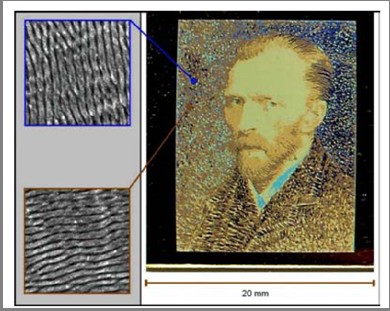
Colour marking by controlled nanostructuring. The image is written on metal with a femtosecond laser; the colours come from the orientation and period of the laser-induced ripples, not from any ink. Insets: two zones with different ripple orientations.
The oldest of these applications is also the most direct. Laser-induced periodic surface structures diffract; change their period or their orientation and the reflected colour changes with the viewing angle. Encoding an image as a map of local ripple orientation therefore produces a permanent, ink-free colour marking, readable by eye and hard to counterfeit: the surface carries the information in its geometry.
This was the first demonstration that the periodic relief is a controllable optical object rather than a defect, and it is the reason the field cares about the direction of the structures as much as their period. The whole discussion of polarization and near field in theme 05 has this as its practical counterpart.
03Can a texture keep hydrogen out?
Hydrogen embrittlement is decided at the entry, not in the bulk: what matters is how much hydrogen crosses the first nanometres. Two textures were written on a Fe-Cr alloy, low spatial frequency ripples (LSFL) and high spatial frequency ripples (HSFL), then compared to a mirror-polished reference by electrochemical permeation.
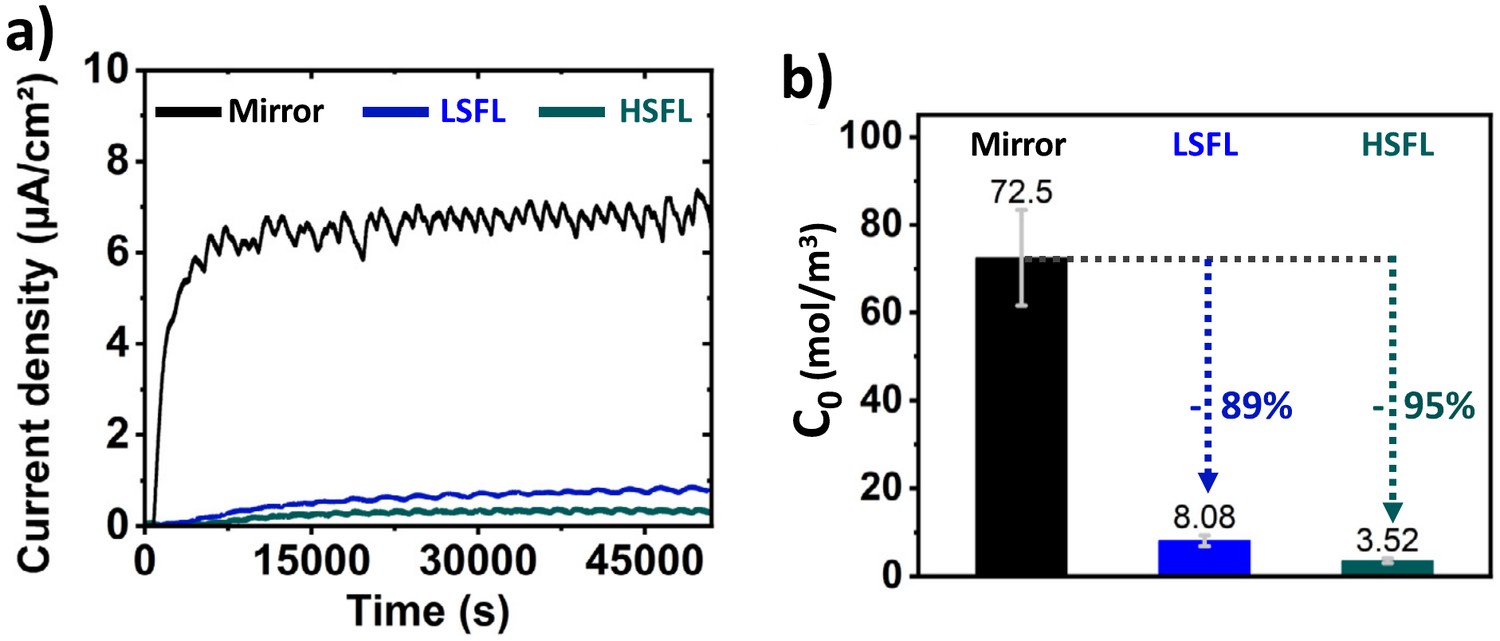
The reduction is large, 89% for LSFL and 95% for HSFL, and it is not a corrugation effect. Dissolving the oxide in a citric acid bath brings the uptake back up on both textures, which places the barrier squarely in the chemical register. What the pulse leaves behind is a 2 to 5 nm film with a duplex stacking of iron and chromium oxides, partly crystalline on HSFL, quite unlike the native oxide that grows on a polished surface.
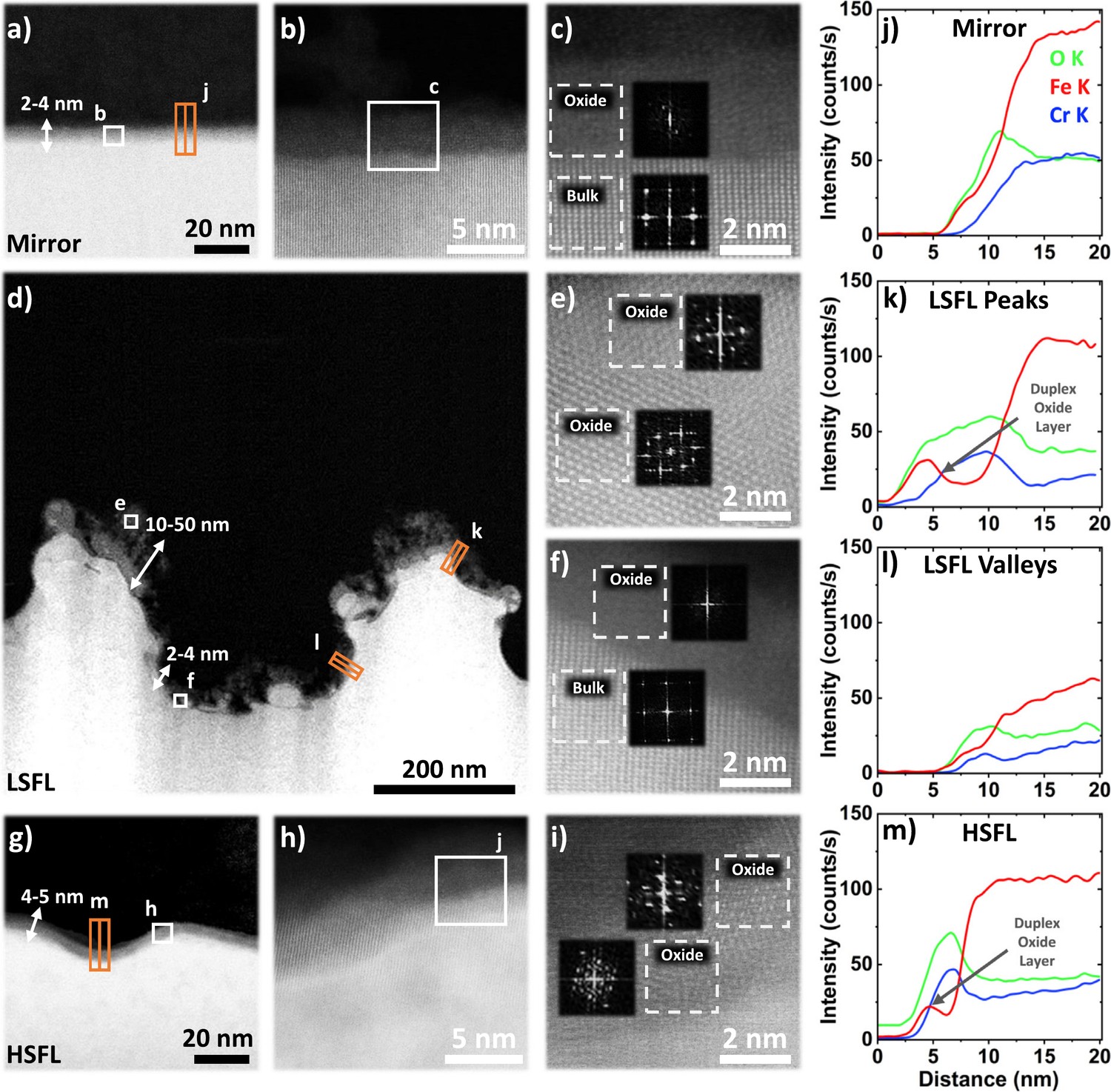
Topography is not irrelevant, it is second order: at comparable oxide thickness, a relief with high skewness and high kurtosis still cuts permeation by a further 40%. The specification for a hydrogen-resistant surface is therefore a pair, an oxide stacking and a height distribution, both fixed by the same shot. Whether a two-dimensional pattern, written by crossing polarizations, can push the effect further is the obvious next test.
04Chemistry rearranged by the pulse
Metallic glasses make the chemical register visible, because they have no grains to hide it. On a Zr50Cu50 thin film, the crest of a ripple is no longer the alloy that was deposited: a copper-rich cap about 60 nm thick sits on a zirconium and oxygen layer about 130 nm thick, and the matrix now holds monoclinic zirconia crystallites and face-centred cubic copper nanoparticles.
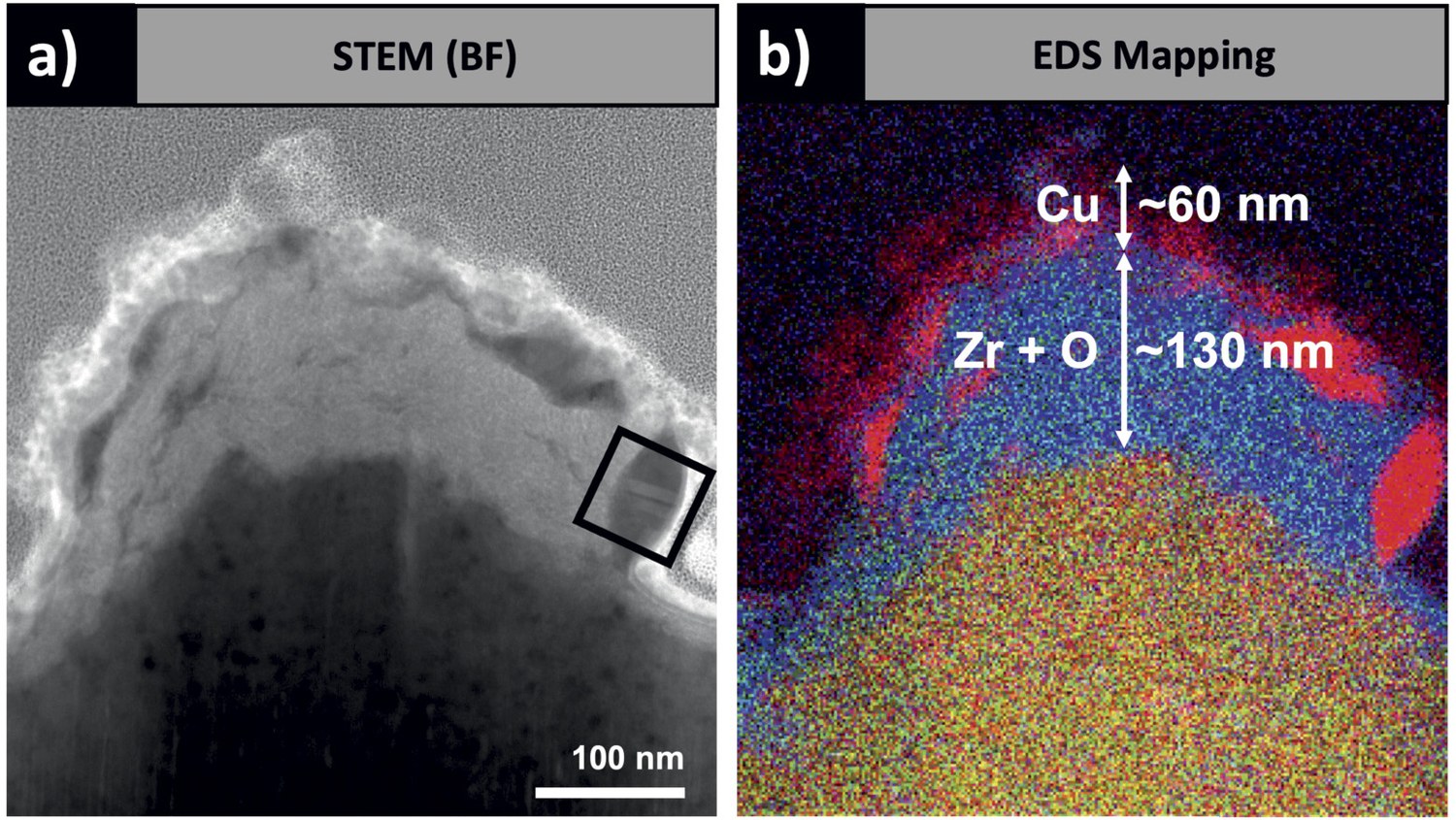
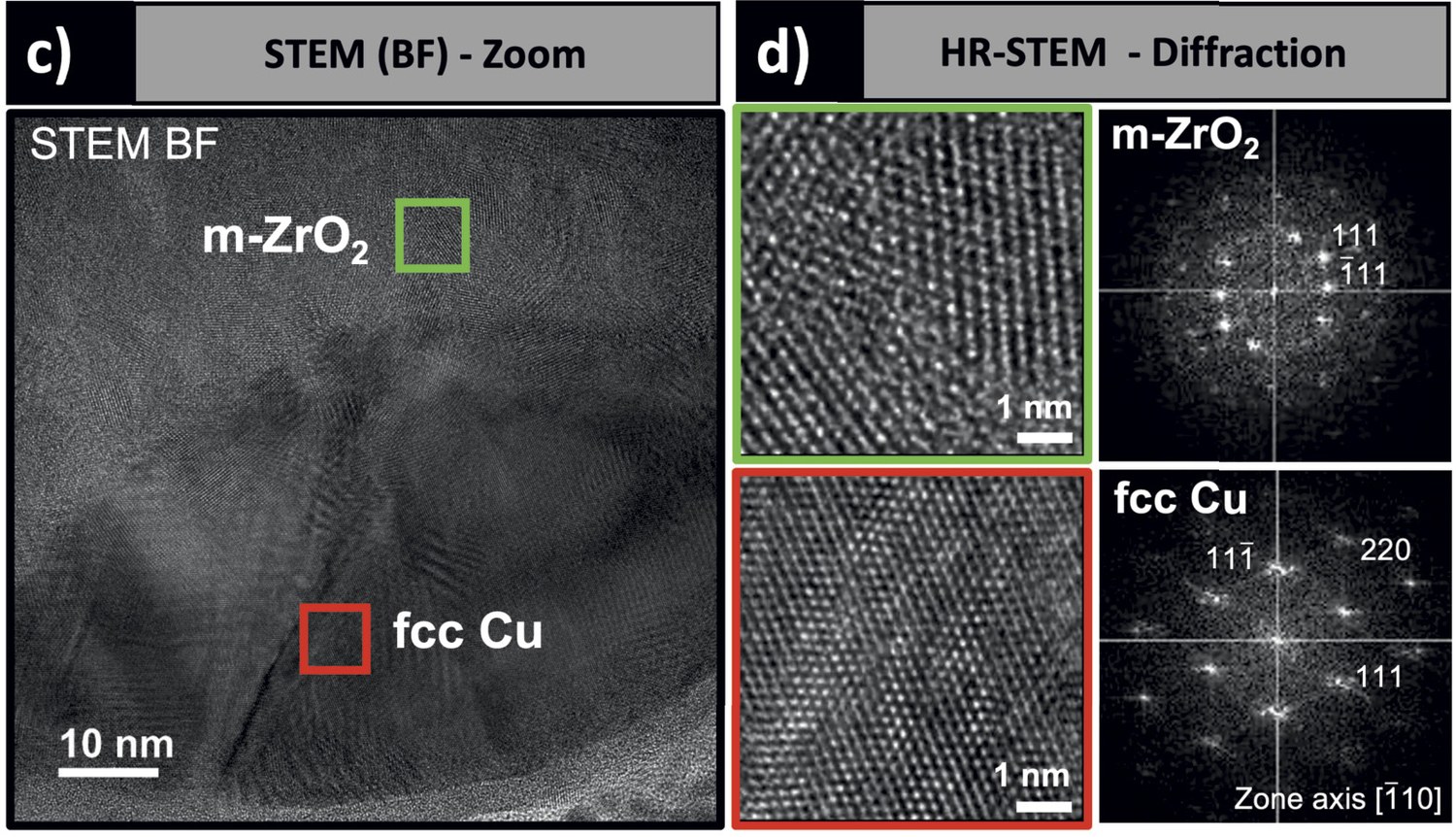
The mechanism is a race between oxygen supply and resolidification. Oxygen from the air reaches a surface that is still hot and reacts preferentially with the element of higher oxygen affinity, here zirconium. The rejected copper accumulates where the oxide does not form, then freezes as nanoparticles when the undercooled liquid crystallizes.
The same sequence runs on Ti50Cu50 and Zr67Ag33, which turns it into a design rule rather than an anecdote. Choosing the binary system chooses which element ends up as the oxide matrix and which ends up as the metallic nanoparticle.
On Zr65Cu35 the same irradiation opens a dense array of nanowells about 20 nm across, with a flared profile well suited to holding a molecule once it is in. The wells are not written by the light. They nucleate on the nanometric interstices left between the columns of the sputtered film, so their density and size are set by the deposition rather than by the beam. Cavitation localizes at those defects while the pressure is still confined, and the local oxidation that follows converts the glass into a composite of monoclinic zirconia in an amorphous ZrCu matrix.
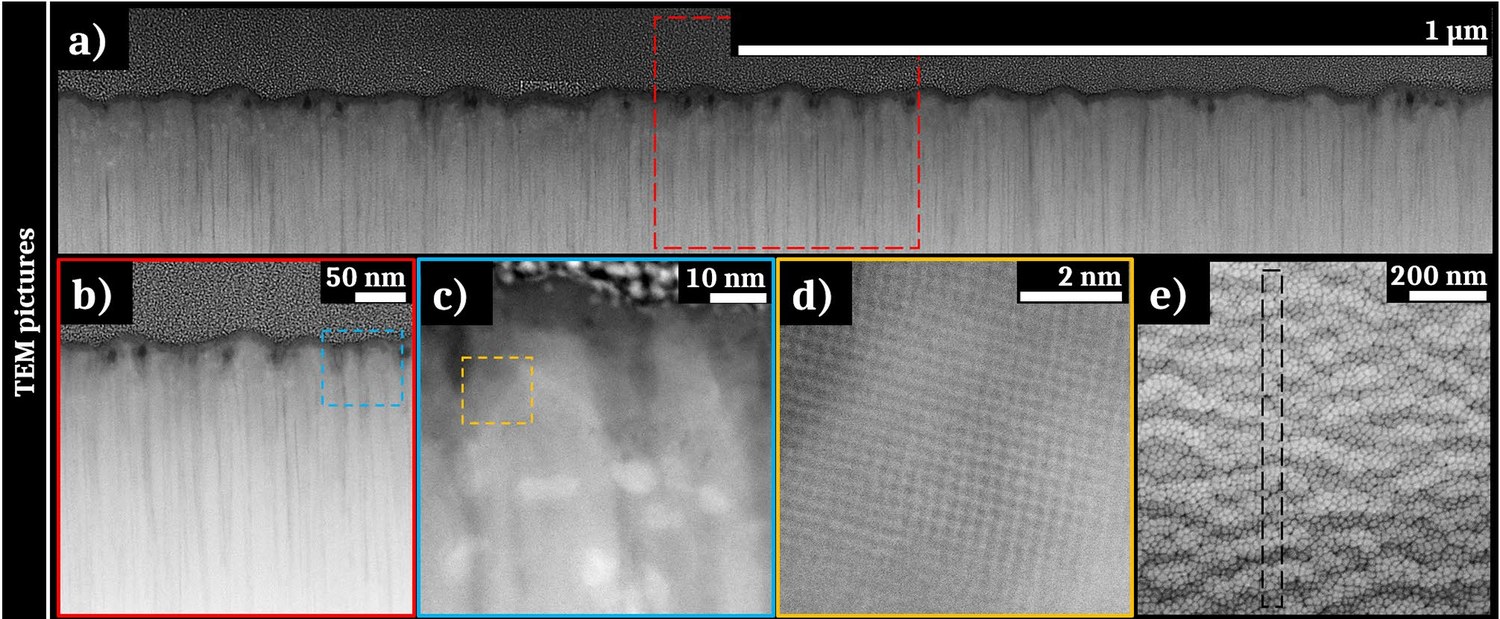
One shot delivers a container and a new material around it: a topographic function and a chemical function written together.
05What decides how a droplet sits?
Wetting is where the registers refuse to be separated, so it has to be attacked with two half-experiments. Fix the geometry and change the chemistry, then fix the chemistry and change the geometry.
The first half is done on tungsten. High spatial frequency ripples of the same period and the same sub-20 nm amplitude are written in ambient air and at 10-7 mbar. The relief is identical; the chemistry is not. In air, the surface crosses the 1273 to 600 K window in 7.2 ns, long enough for oxygen to diffuse about 2.8 nm and for a crystalline monoclinic WO3 layer roughly 2 nm thick to grow. In vacuum, only the native amorphous oxide is there.
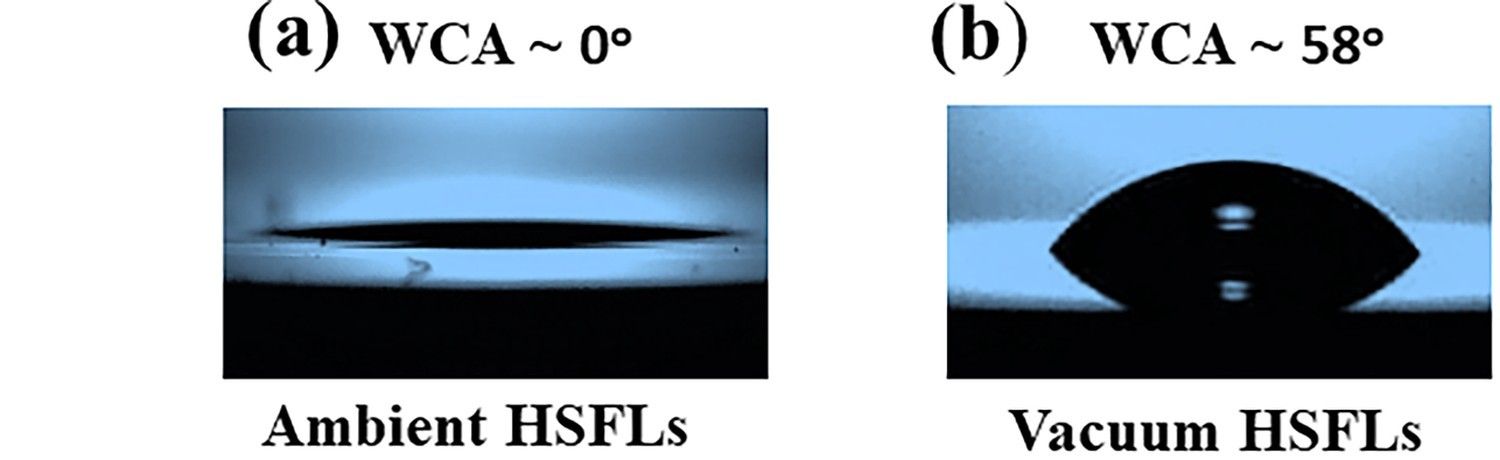
The contact angle is near 0 degrees on the ambient ripples and about 58 degrees on the vacuum ones. Crystalline WO3 carries the higher surface energy, so it wets better than the amorphous native film. Over 84 days both surfaces drift towards larger angles as hydrocarbons adsorb, and the two curves never cross. On a fixed relief, the chemical register alone spans almost the entire hydrophilic range.
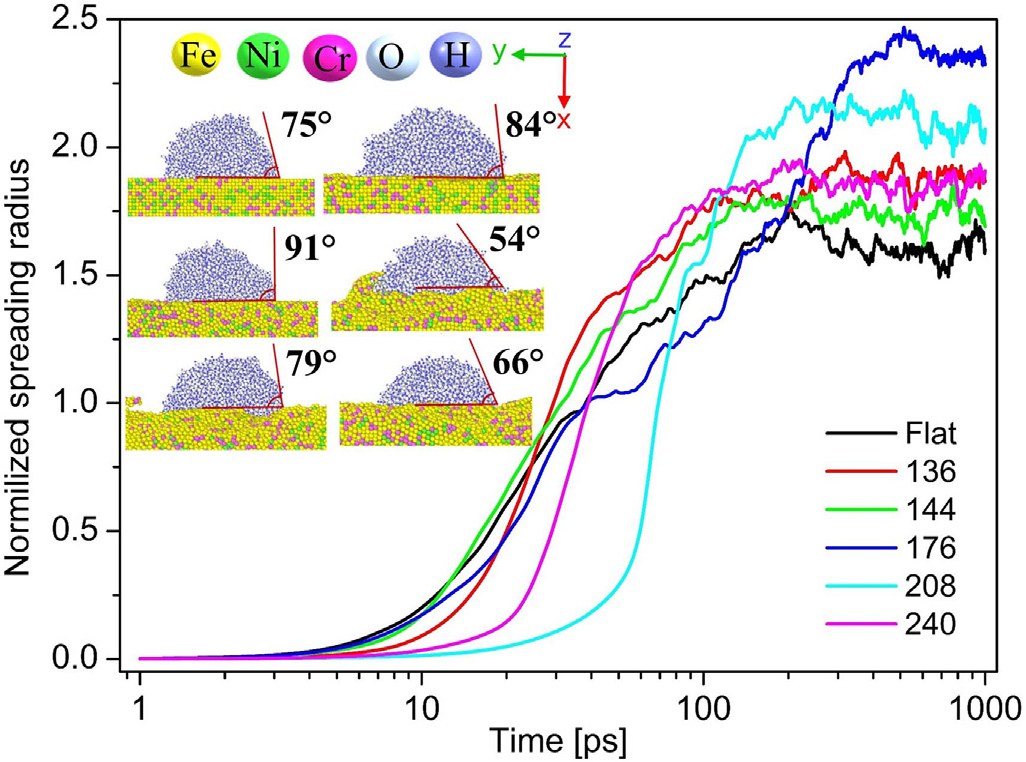
The second half is done in molecular dynamics on 316L stainless steel, where the chemistry can be held strictly fixed. The surfaces are the ones produced by the simulated irradiation, and a water nanodroplet is dropped on each. The flat reference gives 75 degrees, in agreement with measurements on smooth 316L.
What follows is not monotonic. The angle rises to 84 degrees at 136 mJ/cm2 and to 91 degrees at 144 mJ/cm2, where the surface turns hydrophobic, then falls back to 54, 79 and 66 degrees at 176, 208 and 240 mJ/cm2. The normalized spreading radius follows the same alternation, 2.5 and 2.2 on the nanobump surfaces against 1.7 once nanocraters dominate. Wenzel and Cassie-Baxter take turns as the relief changes from dense nanobumps to breached craters.
Put side by side, the two halves bracket the problem. Geometry alone, at fixed chemistry, spans 54 to 91 degrees. Chemistry alone, at fixed geometry, spans 0 to 58 degrees. Neither register is sufficient and neither is negligible, which is why a wetting specification cannot be met by scanning laser parameters and measuring afterwards. It has to be posed as a target in both registers at once, and that is a modelling problem.
06Why this closes the loop
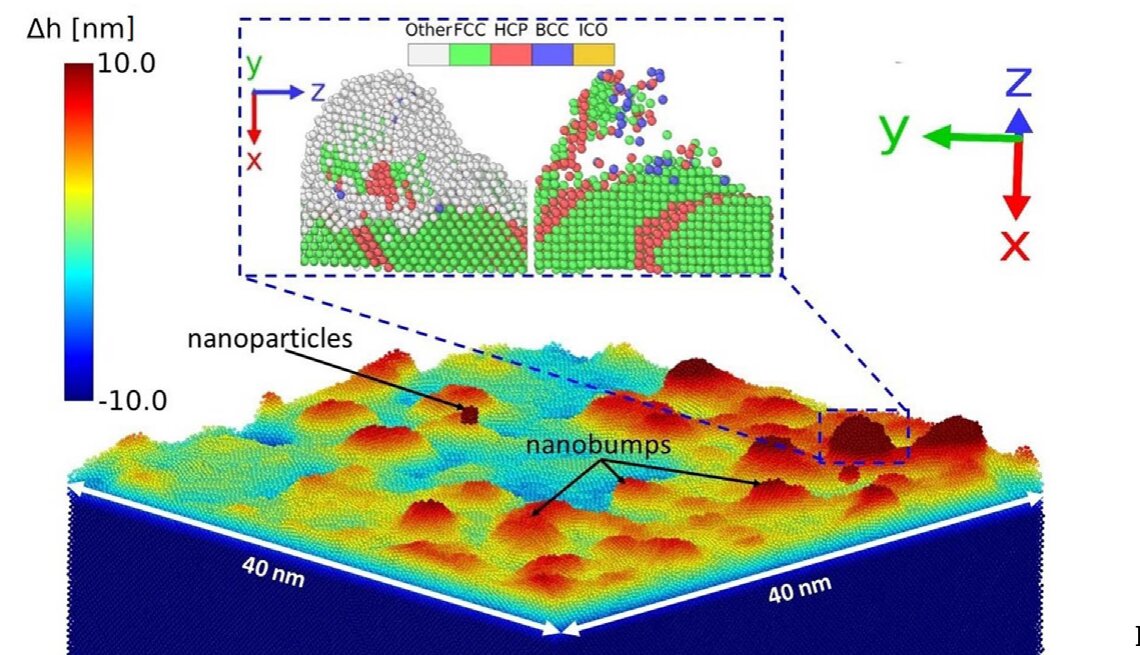
Every property collected here was carried by a state a few nanometres deep, and that state is the last item of the cascade the rest of this site follows. The excited electronic structure fixes how much energy is absorbed and how fast it moves. The electromagnetic organization fixes where it is deposited. The quench fixes the grains, the defects and the residual stress. The hydrodynamics fixes the relief.
The oxide then forms in the nanoseconds that follow, inside a temperature window that the same simulation predicts. A functional specification is a target at the far end of that chain, in three coupled registers, and parameter spaces of that size do not yield to trial and error.
Key papers.
A. Nakhoul et al., Periodic laser surface texturing limits hydrogen ingress in Fe-Cr alloy, Acta Materialia 291, 120995 (2025). doi
M. Prudent et al., Ultrafast laser-induced topochemistry on metallic glass surfaces, Materials & Design 244, 113164 (2024). doi
M. Prudent et al., High-density nanowells formation in ultrafast laser-irradiated thin film metallic glass, Nano-Micro Letters 14, 103 (2022). doi
P. Dominic et al., Unveiling nature and consequences of tungsten oxidation upon ultrafast laser irradiation, Applied Surface Science 655, 159580 (2024). doi
D. Iabbaden et al., Ultrafast laser-induced surface restructuring and local wettability of SS316L, Materials & Design 264, 115714 (2026). doi

