Research theme 07
Learning to absorb light: light organizes, matter remembers
Matter does not merely receive light: it responds to it. Under light’s action, matter transforms, organizes itself, and gradually reshapes its own way of absorbing energy. From mineral formations to plants, this capacity to let an order emerge that fits the flows running through it seems to belong to matter well before life itself appeared. What we call learning might then be understood differently: as a system’s capacity to inscribe, in its own structure, the effects of what it has experienced.
Complexity, self-organization and machine learning for ultrafast laser processing. With Fayad Ali Banna, Eduardo Brandao, Anthony Nakhoul, Rémi Emonet and Marc Sebban, in collaboration with the Inria MALICE team.
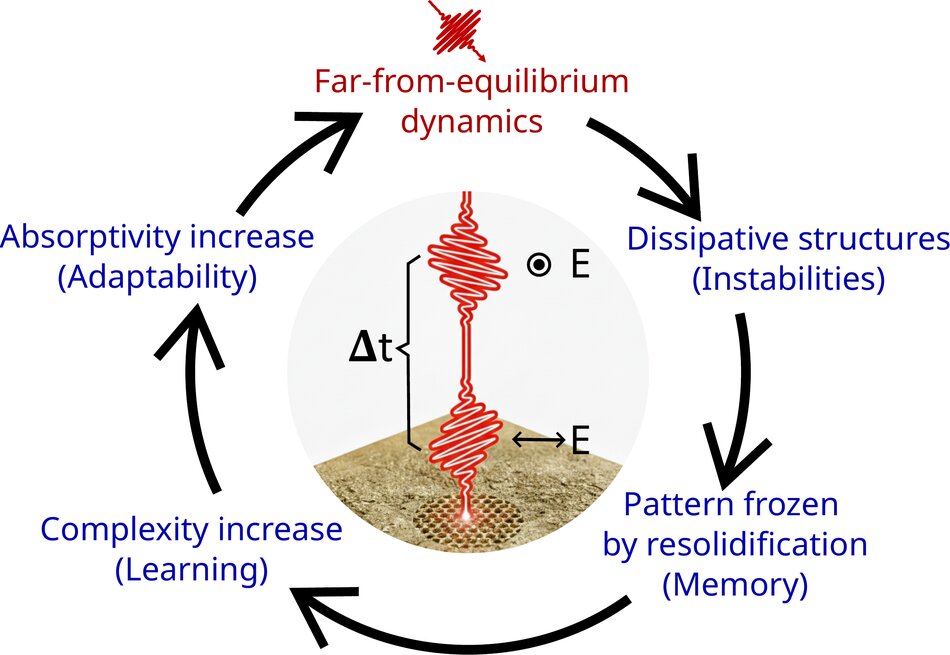
01A surface that keeps a record of the light it has seen
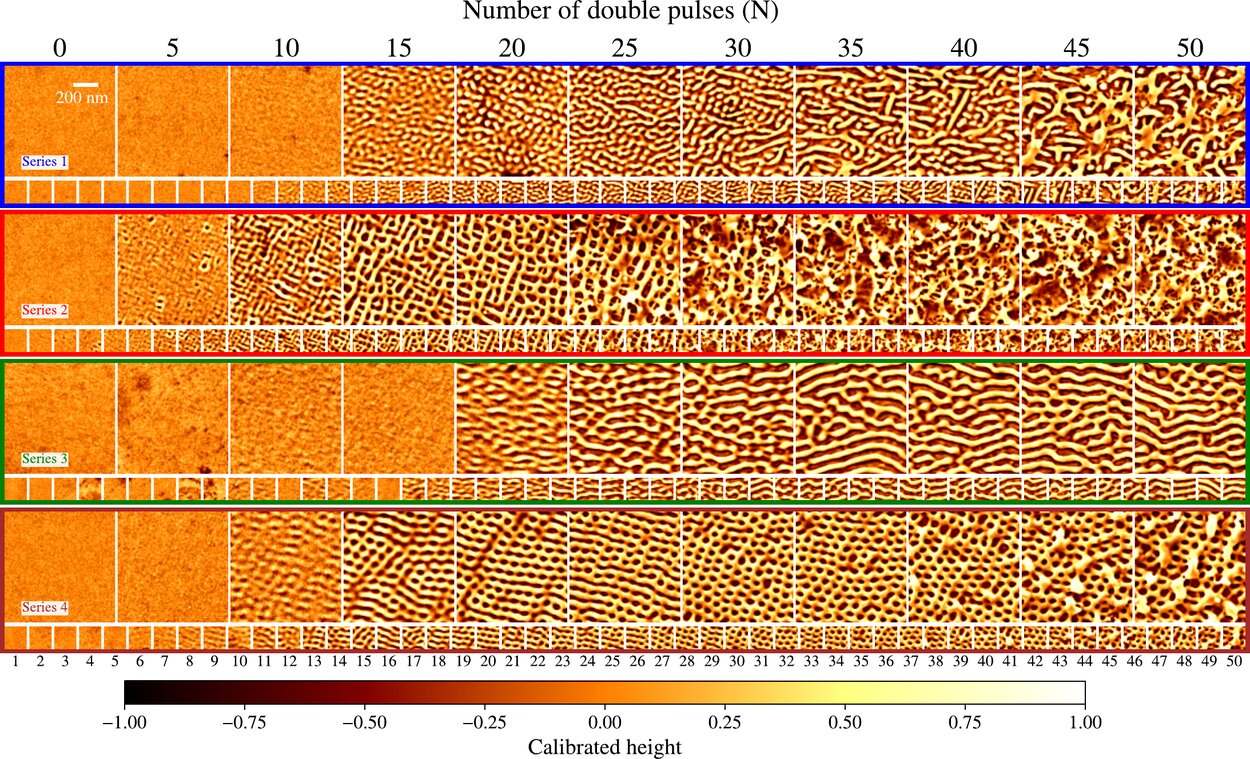
The experiment is deliberately simple. Nickel is irradiated with cross-polarized double pulses, two orthogonal linear polarizations fired in succession with a controlled delay, and the surface is imaged after an increasing number of pulses, up to fifty, for several combinations of fluence and interpulse delay. What appears is a sequence: first a diffuse roughness, then oriented ripples, then a well-formed two-dimensional network, then a breakdown into disorder.
The important point is that the surface at pulse N is the initial condition for pulse N+1, and not in a trivial way. The frozen relief determines where the next pulse deposits its energy, which determines where the melt flows, which determines the next relief. This is the same electromagnetic feedback described in the theme on nanoscale electromagnetism, but followed here over tens of pulses and read as an information process rather than a pattern-formation one.
02Two numbers: how much is absorbed, and how organized it is
The first quantity is the absorbed energy, computed from the measured height map by solving the electromagnetic problem on the real surface and integrating the deposited energy. It is averaged over six polarization angles so that it measures the propensity of the morphology to absorb, not the answer to one particular orientation.
The second quantity has to capture organization without rewarding either perfect order or pure noise. A perfect grating and white noise are both uninteresting; what matters is the regime in between.

Energy absorbed by the surface at pulse N, obtained by integrating over the surface the depth-integrated absorption computed from the measured topography. Normalized by the value for a flat surface, so that different fluences can be compared.
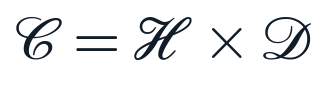
Statistical complexity in the López-Ruiz, Mancini and Calbet sense: Shannon entropy times disequilibrium. Here in its Taylor form, adapted to surface height maps.
Statistical complexity does exactly that. It is the product of the Shannon entropy, which grows with randomness, by the disequilibrium, which measures the distance from a uniform distribution and therefore grows with structure. The product is maximal for a system that is neither too ordered nor too random, which is precisely the signature of a dissipative structure.
Plotting the two quantities against the number of pulses for four independent experimental series gives the central result of this work: they rise together, plateau together, and then part company.
03Four phases, and the criterion that separates them
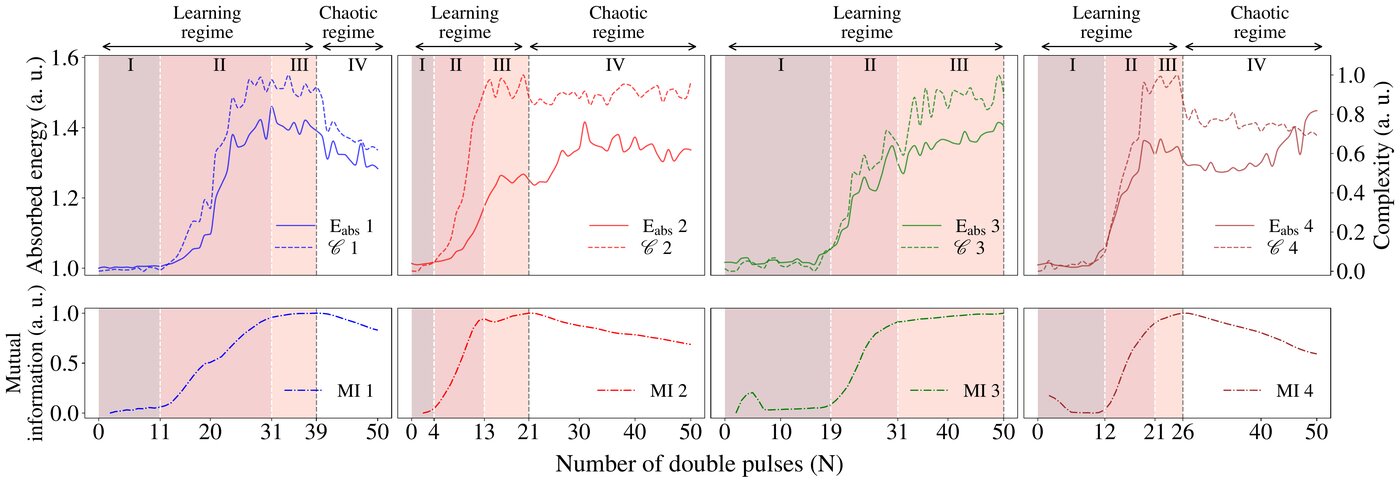
The trajectory splits into four phases, and the boundaries are not drawn by eye. They follow from the mutual information between absorbed energy and complexity, computed cumulatively as the number of pulses grows, which measures how strongly the two are coupled including through nonlinear dependencies.
In the response phase the surface merely detects the stimulus: roughness appears, hydrodynamic instabilities are transient, and both quantities stay flat. The iterative learning phase begins when two conditions are met at once, a roughness amplitude large enough to create significant near-field inhomogeneities, and thermal conditions allowing Rayleigh-Bénard-Marangoni convection to develop within the lifetime of the molten layer. Absorption and complexity then climb together.
The memory stabilization phase is a kinetic arrest: the time needed for the convective pattern to reorganize exceeds the melt lifetime, so the morphology freezes in an optimized configuration and complexity reaches a plateau. Finally the destruction phase sets in when the deposited energy exceeds what structure-preserving processes can absorb. Enhanced absorption at the optimized nanostructures produces thermal runaway at the hotspots, material is removed, and the two quantities decouple: absorption keeps rising while complexity falls. The drop in mutual information marks that transition, and it is the boundary between a learning regime and a chaotic one.
The system overlearns. Prolonged exposure produces a state so finely optimized for absorption that it destroys itself.
04Why the trajectory has a direction
A history-dependent process is not automatically a learning one. What makes this trajectory directional rather than a random walk in configuration space is a physical feedback loop with a definite sign.
Each pulse deposits energy with a spatial distribution set by the existing topography. Where absorption is locally higher, the melt is hotter, the thermal gradients are stronger and the material transport is faster, so those modulations grow at a higher rate. When resolidification freezes the relief, the geometry that enhanced absorption is the one that survives, and it enhances absorption again at the next pulse. Morphologies that couple light in are therefore selected, not by an optimizer but by the dissipation itself.
The loop runs: far-from-equilibrium dynamics, dissipative instability, freezing by resolidification, increase in complexity, increase in absorptivity, and back to far-from-equilibrium dynamics. It has a close analogue outside the laboratory in snow penitentes, where pointed structures emerge under solar irradiation because differential absorption and sublimation couple geometry to energy dissipation in exactly the same way.
05The surface answers best to the polarization that made it
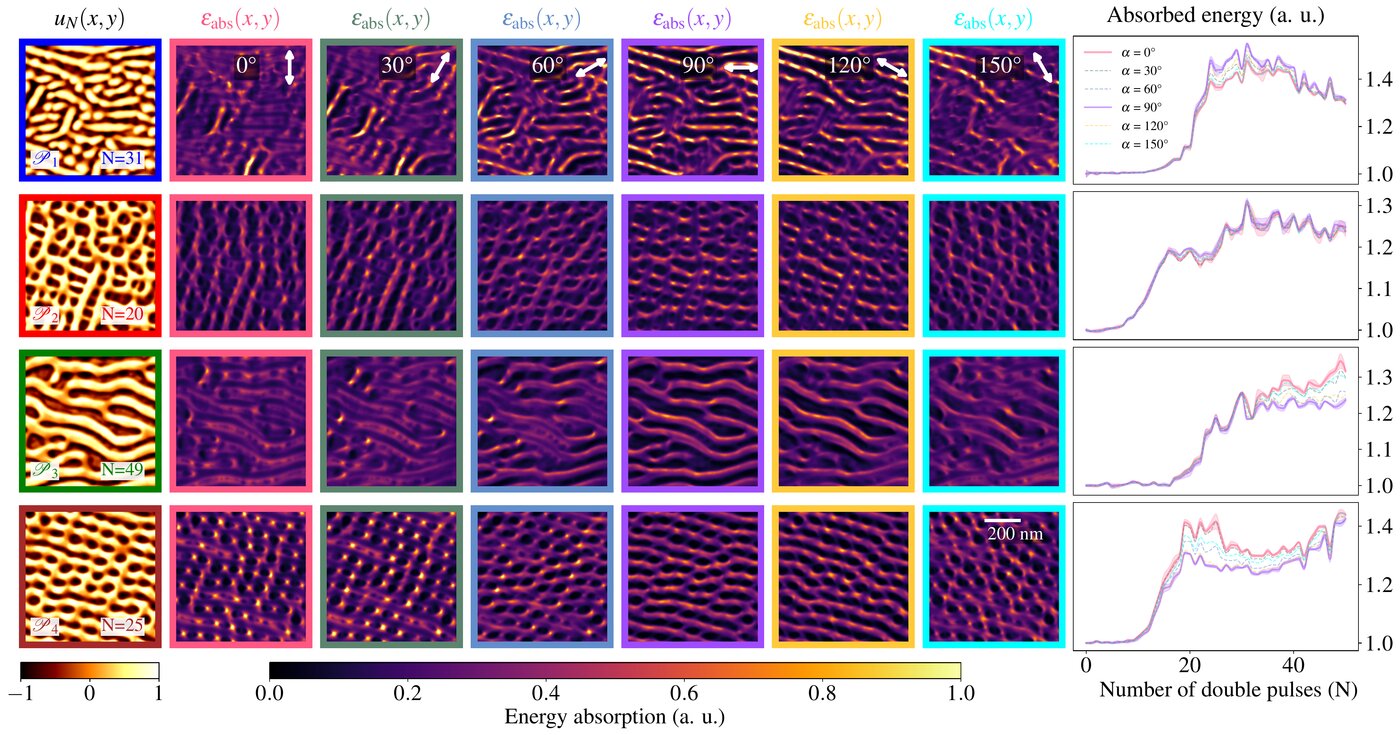
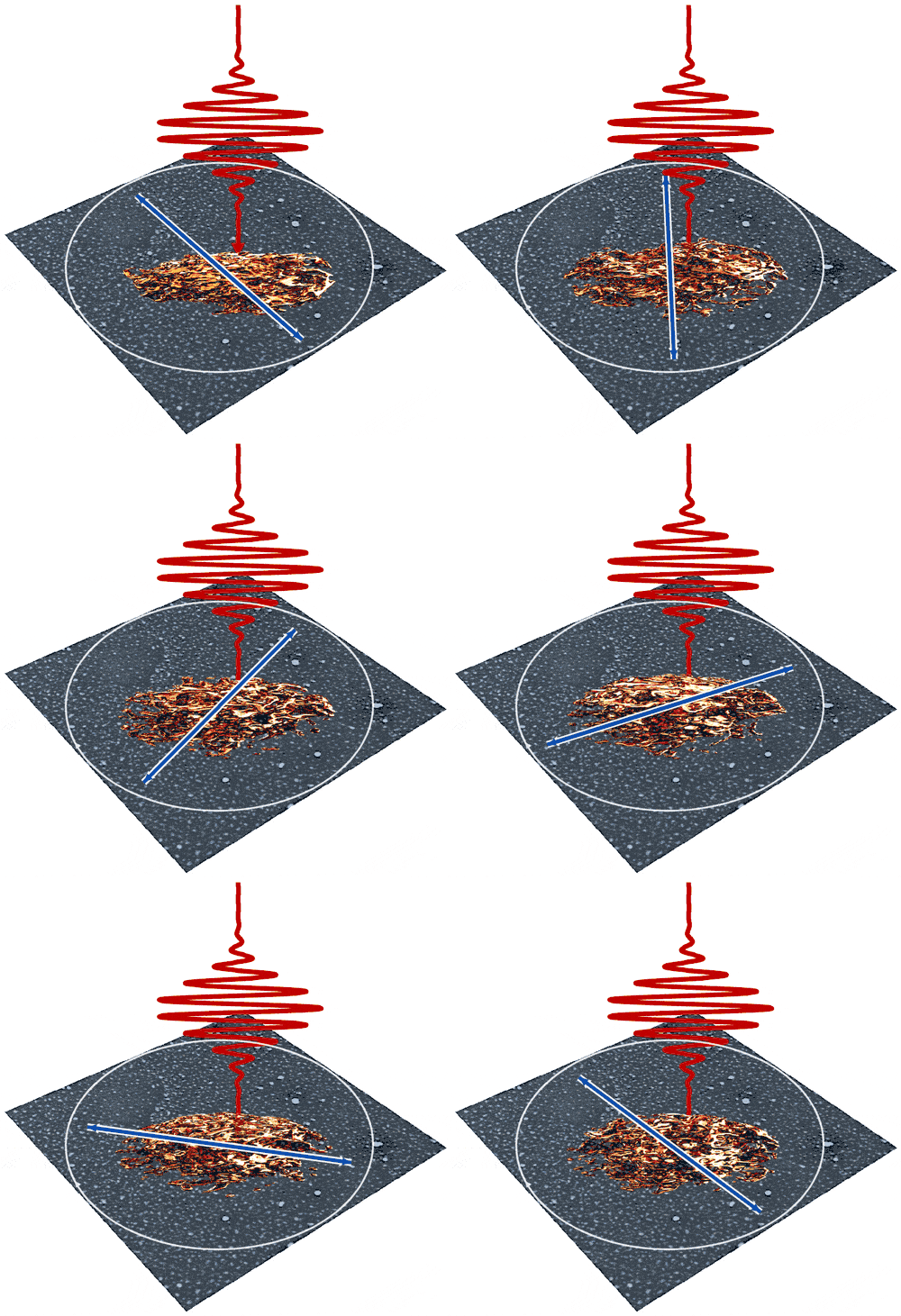
If the surface really stores information about the light it has seen, then it should respond preferentially to that light. Testing this means taking a pattern that maximizes absorption and recomputing the absorption for six polarization angles.
Structures parallel to the field absorb more, and the peaks of highest curvature dominate while the valleys stay dark. As the number of pulses grows, curves that were superimposed separate, and the two experimental polarization angles, the ones actually used to write the structure, become the upper and lower bounds of the whole family. The surface has become anisotropic in its sensitivity, and the anisotropy is aligned with its own history.
This is the behaviour that non-associative learning calls sensitization: repeated exposure to a stimulus increases the response to that stimulus. In an organism it comes from neuroplasticity. Here it comes from a relief whose orientation was written by the field it now responds to.
06How fragile is the optimum?
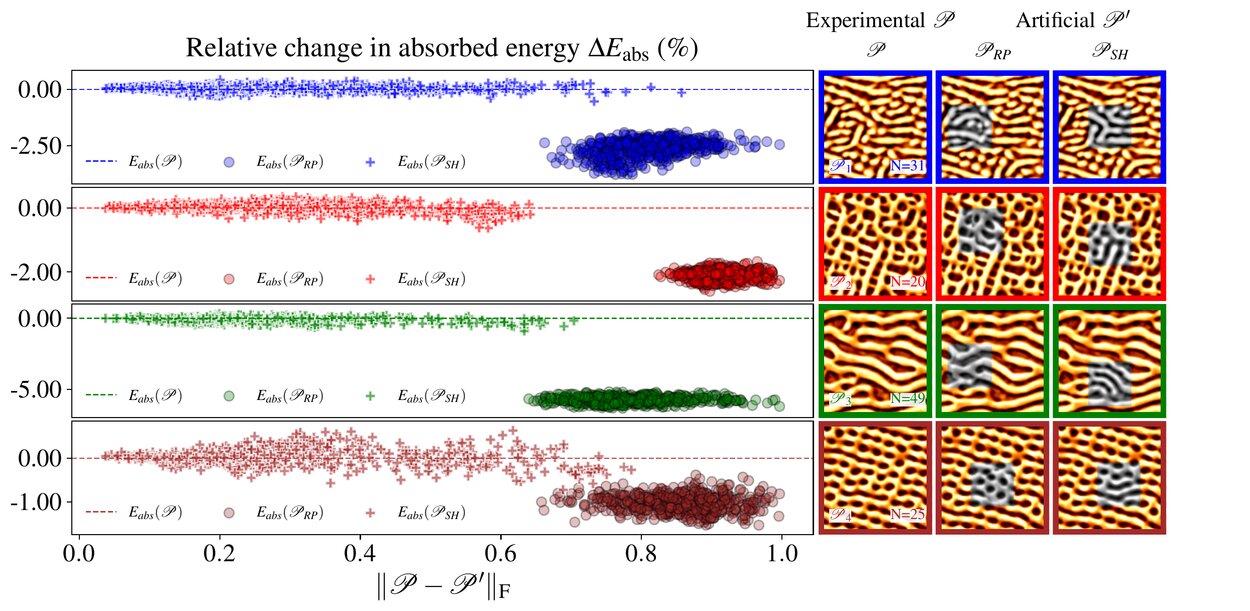
An optimum reached by a physical process should degrade when perturbed, and the way it degrades says what kind of optimum it is. Two perturbations were applied to the pattern that maximizes absorption in each series. The first replaces a patch by another patch taken from a different pattern of the same series: physically plausible material, but locally violating the self-organization law that produced the rest.
The result is unambiguous. Whatever the amplitude of the change, the absorbed energy falls below the reference. The configuration is finely tuned, and a local deviation from the law that generated it costs performance.

Relative change in absorbed energy when a pattern is perturbed, plotted against the Frobenius norm of the difference between the original and the modified height maps.

Swift-Hohenberg equation, the amplitude equation used to generate synthetic patches. It reproduces the pattern-selection dynamics of the thermoconvective instability.
The second perturbation replaces the patch by one generated with a Swift-Hohenberg solver, an amplitude equation that models the hydrodynamic fluctuations and reproduces the same class of patterns. Here the absorbed energy scatters around the reference rather than below it, and stays close to it whatever the amplitude of the change.
The two tests together give the sharpest statement of the paper. The surface is not merely rough in a way that happens to absorb well: it is organized according to a specific dynamical law, and only modifications that respect that law preserve its performance.
07Learning the absorption operator
There is a second, more literal sense in which learning enters this problem. Everything above depends on knowing where the light is absorbed on a given surface, and that map has to be recomputed every time the surface changes. Solving Maxwell’s equations by FDTD on a 320×320 height map takes minutes; following a pulse train, over many realizations, needs tens of thousands of such solves. The absorption step, not the hydrodynamics, is the bottleneck.
Rather than accelerating the solver, we learn the operator it implements (the map that takes a topography to the absorbed energy density it produces), by minimizing the discrepancy with the solver over a dataset of surfaces.

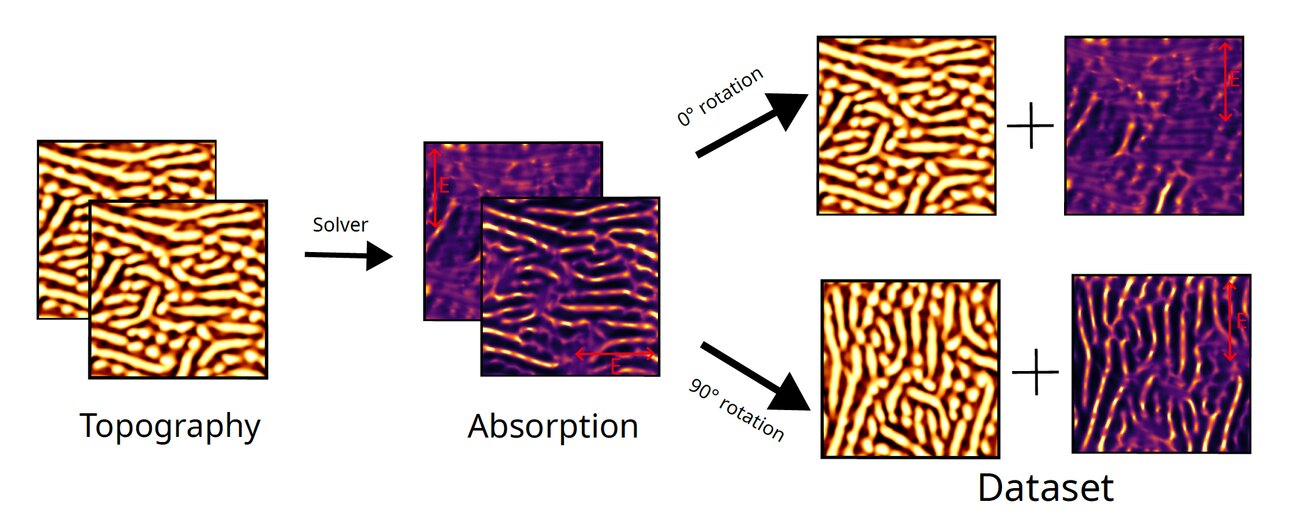
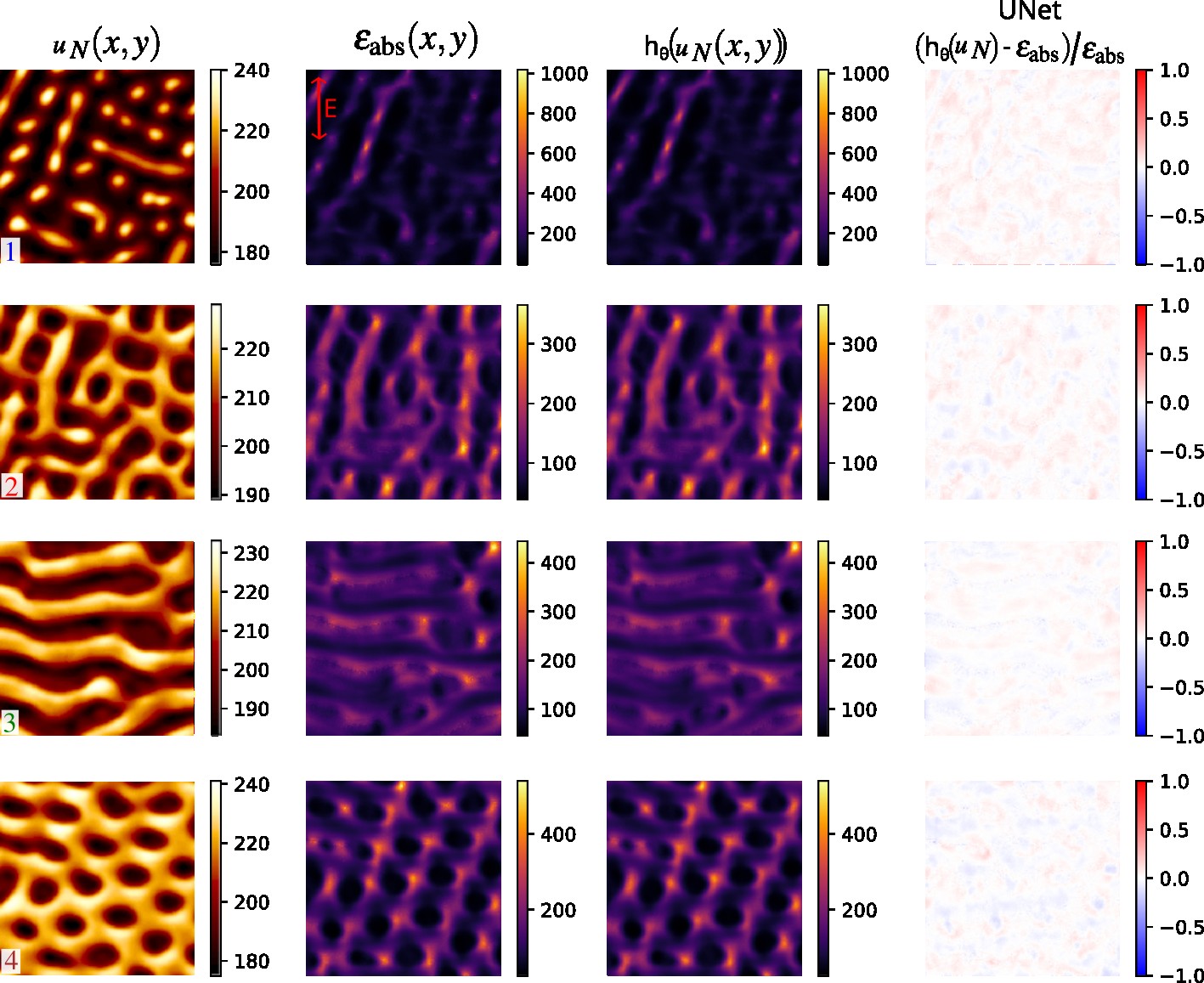
Row after row, the learned operator reproduces the solver to within a few percent on every morphology in the dataset, and evaluates a map more than a hundred thousand times faster. The error panel is the one that matters: it stays flat and structureless, so the surrogate is not simply smoothing the fine detail away. That alone is what makes a stochastic, pulse-by-pulse study of self-organization possible at all.
The interesting part, however, is which architecture wins. Four were put in competition, chosen because they encode two opposite hypotheses about the range of the light–matter coupling. A U-Net is a purely local operator: stacked 3×3 convolutions with a finite receptive field, a few tens of nanometres on the surface. A Fourier Neural Operator is a global one: it multiplies in reciprocal space and can in principle carry a coupling between any two points of the map. Between them sit an FNO with added convolutions, and a U-shaped Neural Operator combining both ideas.
The plain local network wins, in accuracy and in cost. That is not a disappointment for the elegant architectures: it is a physical result. At scales far below the wavelength, the absorbed energy at a point is fixed by the topography in its immediate neighbourhood. The light here is a near field, and the operator that describes it is short-ranged.
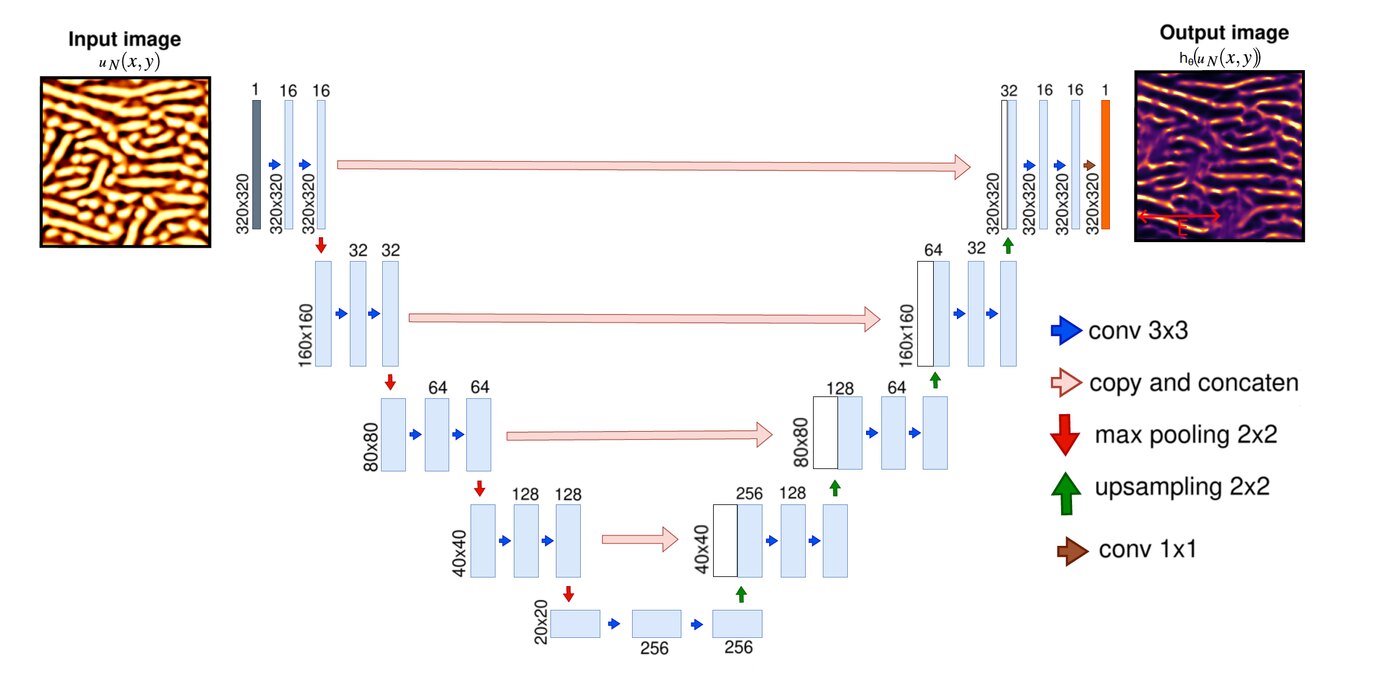
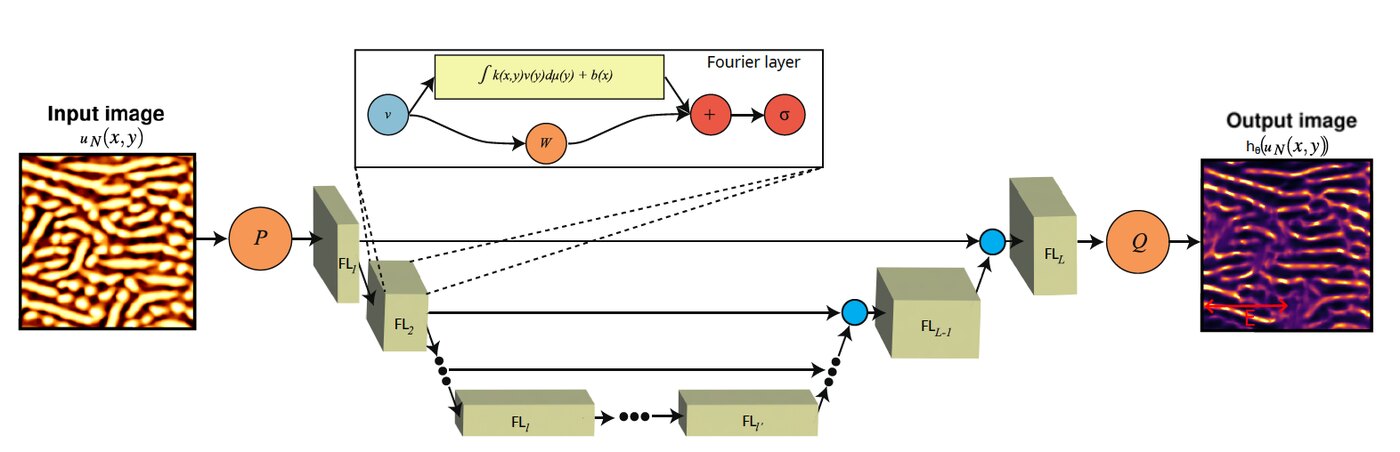
By comparing architectures with different receptive fields, the network therefore measures the range of the electromagnetic coupling on a rough surface, and confirms from data what the near-field analysis argues from the fields themselves. This is the clearest example on this site of a network used not as a predictor but as an instrument.
08What learning means here, and what it does not
Learning is used in the broad sense: a history-dependent evolution that improves performance with experience. Nothing in this system computes, and no analogy with a specific machine-learning architecture is intended. The optimization strategy is inherent to the physics, to Rayleigh-Bénard-Marangoni instabilities coupled to electromagnetic feedback.
What the work does provide is a way of measuring that process rather than describing it qualitatively, and a way of predicting it. Learning the partial differential equation behind an observed sequence of patterns, and using complexity as the quantity to be guided, turns self-organization into something one can steer towards a target morphology instead of merely observing. That is the practical end of this theme, and it connects directly to the electromagnetic and atomistic models developed in the other three.
Key publications
- Photonic learning in ultrafast laser-induced complexityF. Ali Banna, E. Brandao, A. Nakhoul, R. Emonet, M. Sebban, J.-P. Colombier, Ultrafast Science, under revision (2026).
- Learning complexity to guide light-induced self-organized nanopatternsE. Brandao et al., Physical Review Letters 130, 226201 (2023). doi.org/10.1103/PhysRevLett.130.226201
- Learning PDE to model self-organization of matterE. Brandao et al., Entropy 24, 1096 (2022). doi.org/10.3390/e24081096
- Beyond the microscale: advances in surface nanopatterning by laser-driven self-organizationA. Nakhoul, J.-P. Colombier, Laser & Photonics Reviews (2024). doi.org/10.1002/lpor.202301019

