Research theme 03
Devitrification: crystalline order nucleating inside a disordered solid
Scale: nm · ps to ns · order parameter: coordination and short-range order
A glass is a solid without long-range order. Under a femtosecond pulse focused inside it, that disordered network can be driven across a phase boundary and come back out crystalline: devitrified. This theme is about that transition and its reverse: what makes an amorphous solid choose order, and what makes a crystalline one refuse to. The route runs through extreme states held for a very short time. Stishovite, the high-pressure form of silica, forms in the lower mantle and in meteorite craters, where silica is taken past twenty gigapascals and held there long enough to crystallize; a focused pulse reaches comparable thermodynamic states, but for a few hundred picoseconds only. The question is how the network can nevertheless organize itself before the pressure relaxes, and how the quench then keeps what it built.
Multiscale modelling of laser-induced phase transitions in glasses. With Aram Yedigaryan, Elena Kachan, Aram Melkonyan, Djafar Iabbaden and Razvan Stoian, and with the group of Enam Chowdhury at Ohio State University.
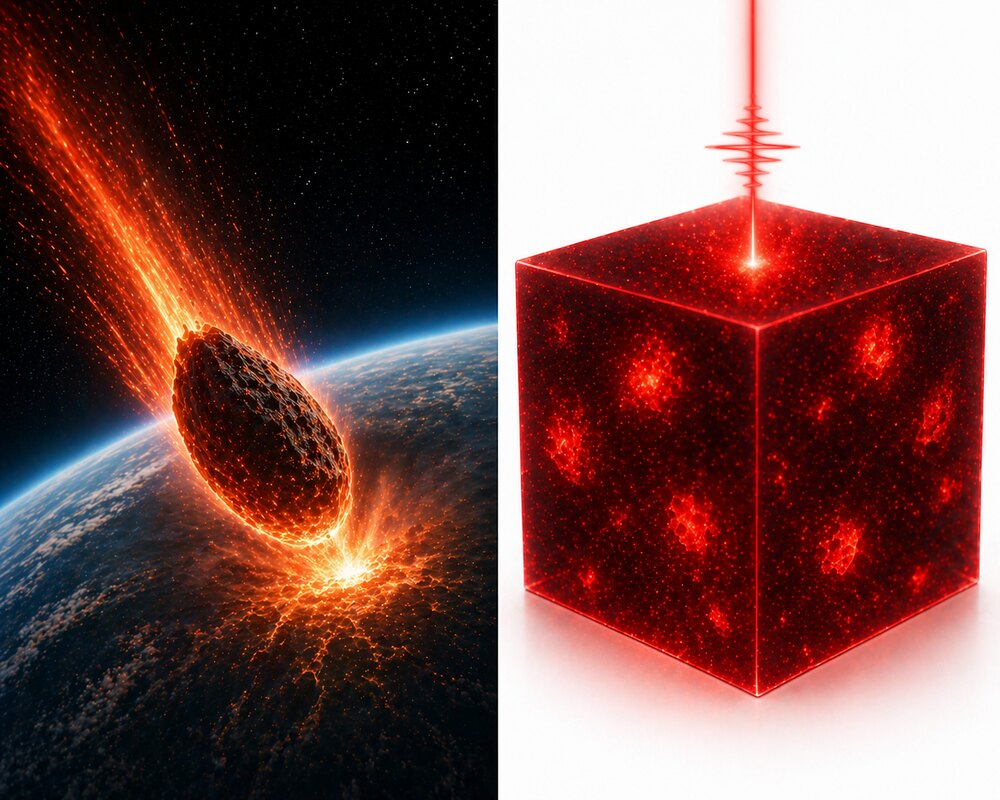
01Reaching the pressure: a pore is an antenna
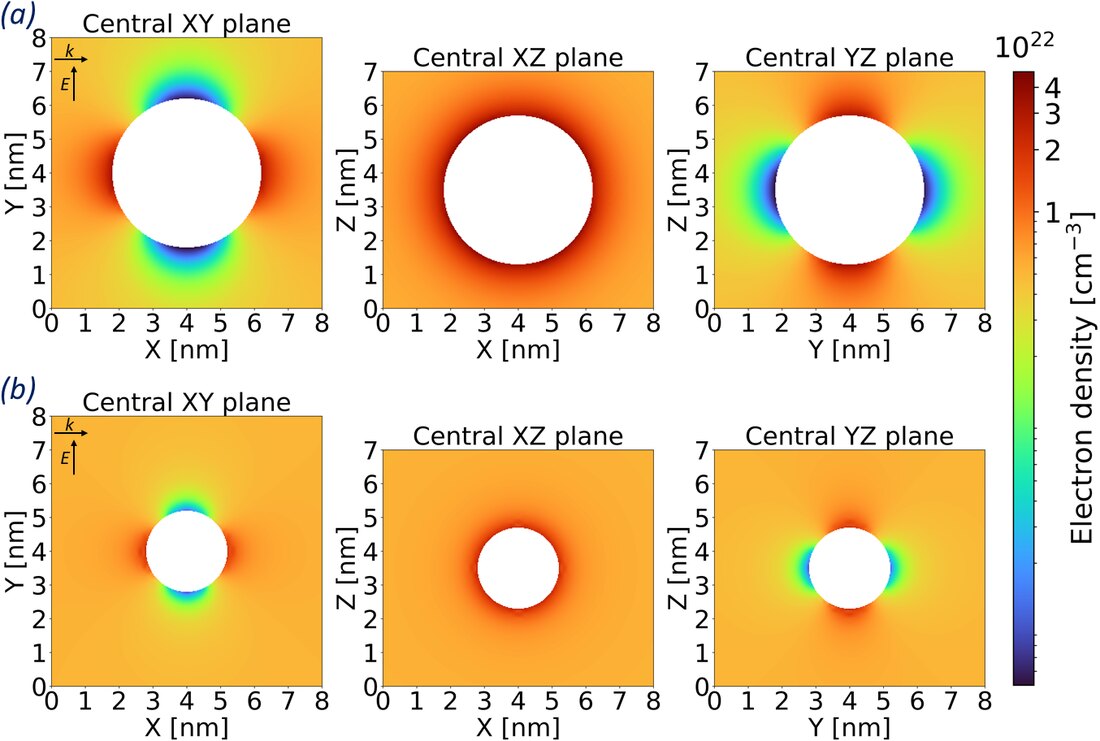
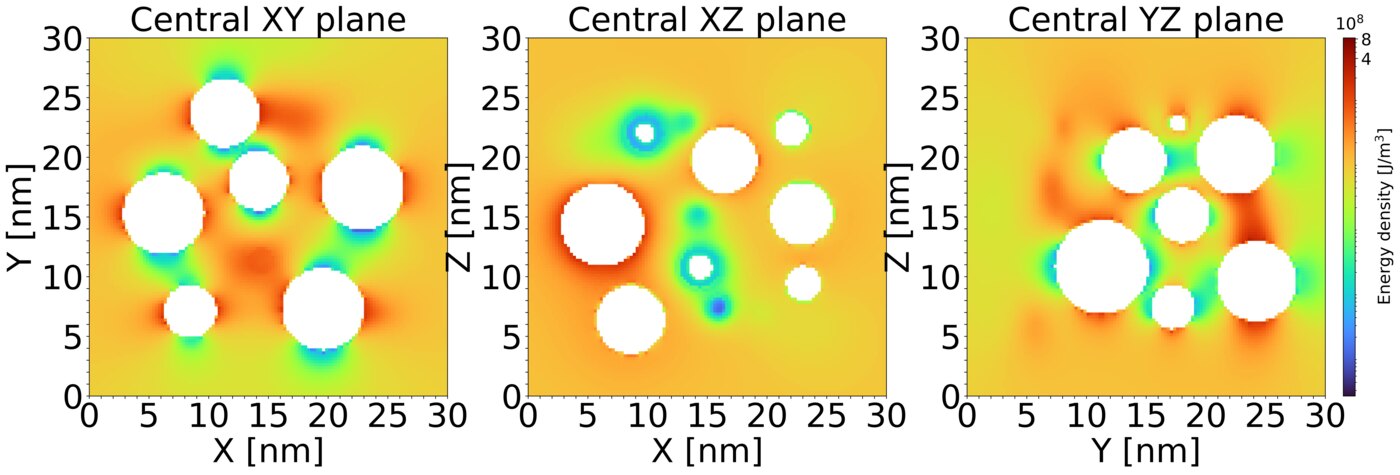
A wide bandgap solid is transparent, so the energy must be deposited nonlinearly: multiphoton and tunnel ionization create carriers only where the intensity is highest, and the absorption becomes a strongly superlinear function of the local field. That nonlinearity is what makes the deposition sub-diffraction, since a modest enhancement of the field produces a large enhancement of the absorbed energy.
The enhancement follows the polarization and is asymmetric between the illuminated and the shadowed side of the pore. It is also how the pores appear in the first place: scattering and photoionization localize the energy, cavitation opens nanovoids, and after a few pulses the irradiated volume is a nanoporous material that has manufactured its own antennas.
02Devitrification: a crystal that beats the pressure
Once the energy is localized and the coefficients of the excited state are known, the atoms can be followed. Coupling the electromagnetic calculation to two-temperature molecular dynamics on a sample of about sixty thousand atoms containing thirty nanopores gives the sequence: the shell around each pore heats first, the pore collapses, and the collapse converts the stored electromagnetic energy into a transient state of high pressure and high temperature in the surrounding network.
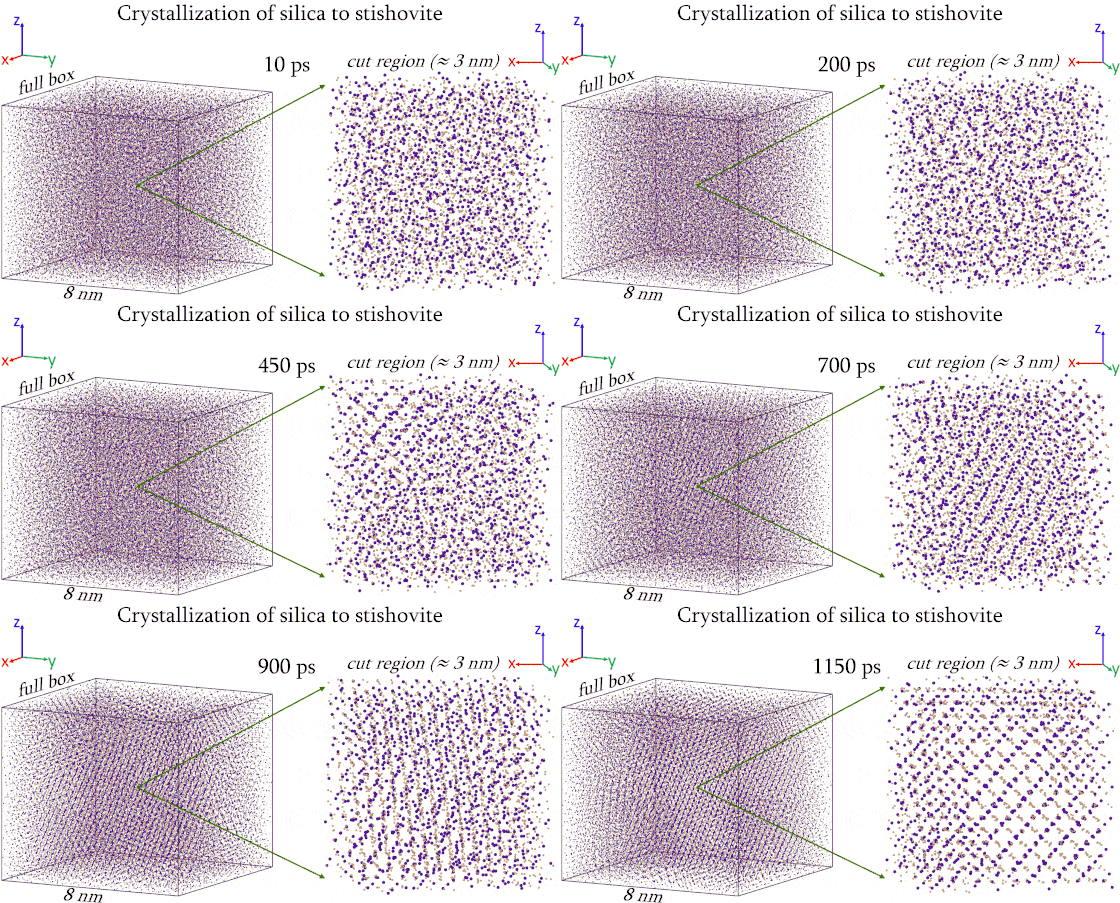
Crystallization starts about four hundred picoseconds after the pulse, and it starts in several places at once. The nucleation sites are not random: they sit where the pores were, because the collapse leaves behind exactly the combination of density, pressure and temperature that lowers the nucleation barrier. Heterogeneous energy localization has become heterogeneous nucleation.
The phase that grows is stishovite, in which silicon is six-fold coordinated instead of four-fold. The partial radial distribution functions of the final structure match those of pure stishovite at the same temperature for the silicon-oxygen and oxygen-oxygen pairs, and the octahedral coordination is confirmed by the bond-angle distribution.
This figure carries the central argument. The transformation is a race: the pressure produced by the collapse relaxes on its own timescale, and the crystal has to nucleate and grow before it does. In the nanoporous sample the crystallization is fast enough to win. In a homogeneous sample that reaches the same average temperature and density, nucleation is delayed and the pressure has already fallen when it starts, so the high-pressure phase never forms.
The inhomogeneity is therefore not a defect to be tolerated but the ingredient that makes the transition possible.
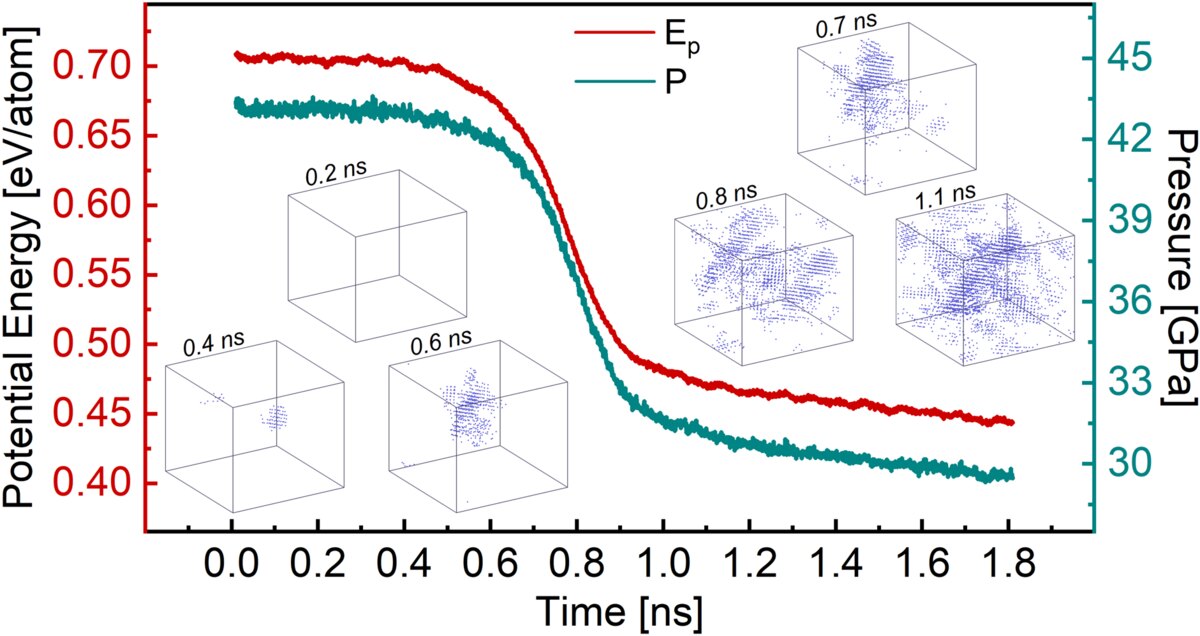
Order does not appear where the energy is highest on average. It appears where the energy was localized early enough for the nucleation barrier to fall while the pressure is still there.
03Which path, and how far it can go
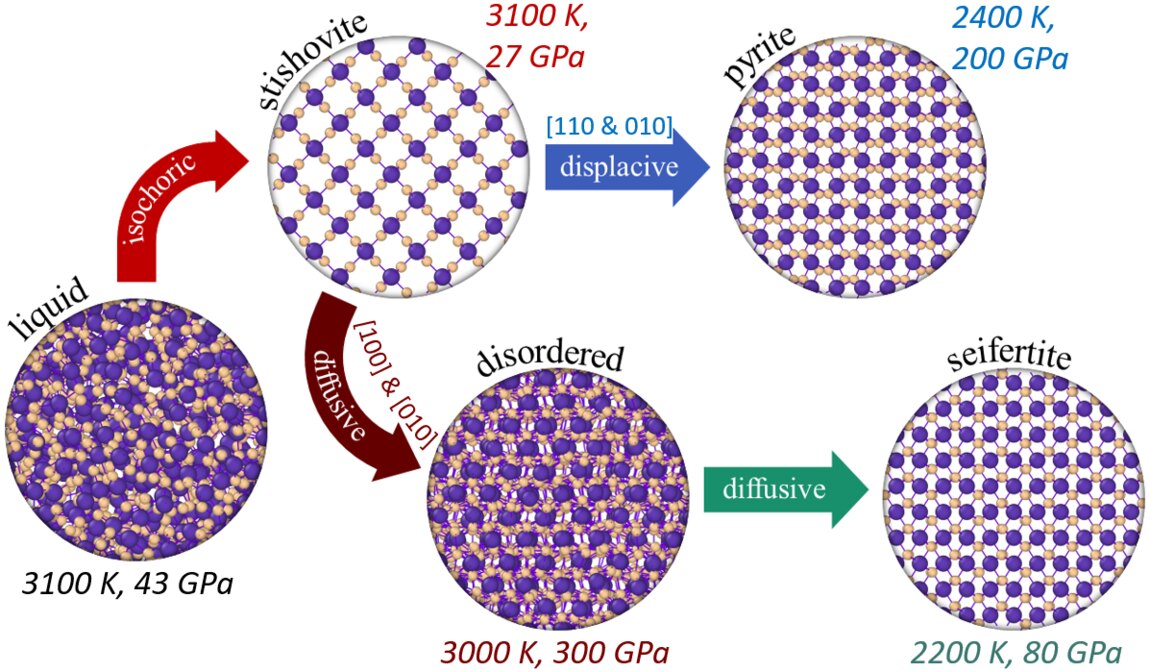
Silica has an unusually rich high-pressure landscape, and the transient state produced by a pore collapse can land on more than one branch of it. The distinction between displacive transitions, where the network shears without breaking bonds, and diffusive ones, where atoms must move past one another, sets both the accessible phases and the time each needs. It also determines whether the quench preserves the new order or returns the material to a glass.
Stishovite itself has a limit: beyond about fifty gigapascals it converts to a post-stishovite orthorhombic phase, so the window in which it can be formed and kept is bounded on both sides. The same reasoning applies to densification without crystallization, where the network compacts by up to a few percent and stays amorphous.
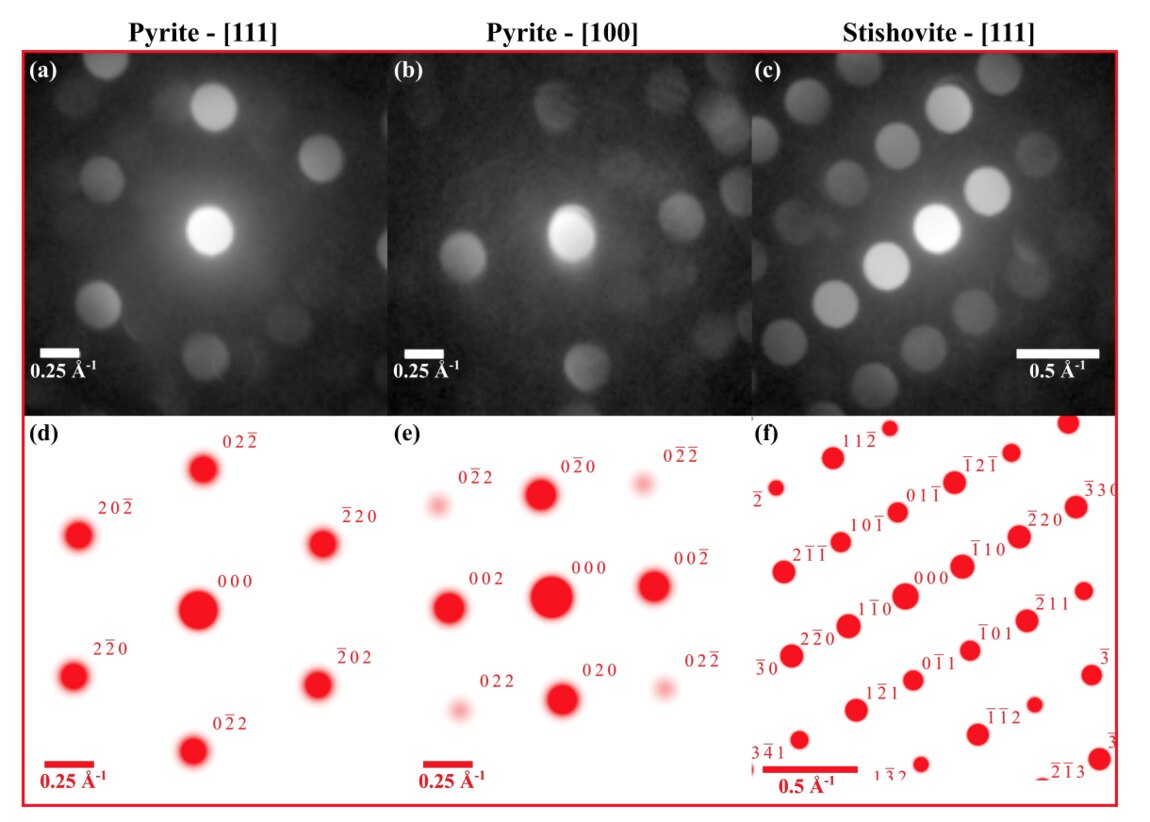
The simulations would remain a claim without this. Diffraction on irradiated samples, in confined geometries and at a silica interface, gives spacings that match stishovite within a few percent. The absence of a preferred orientation is itself informative: it says the crystallites nucleated independently rather than growing from a single front, which is what the atomistic picture predicts.
04The same question in a metallic glass
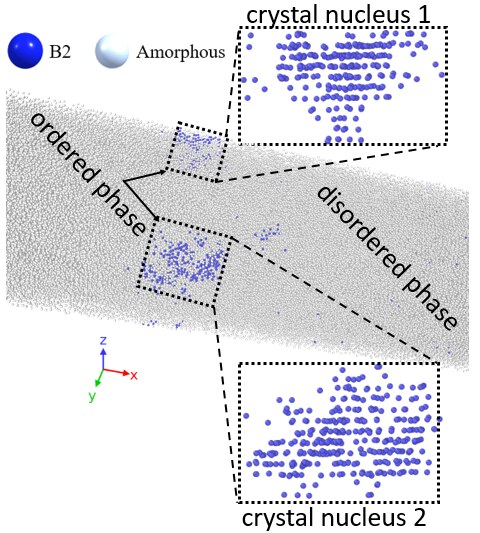
Silica is not the only amorphous solid that can be made to order under a pulse. A copper-zirconium metallic glass poses the same problem with different ingredients: no bandgap, no photoionization, but the same competition between a nucleation rate and a quench rate, and the same question of whether the ordered phase survives.
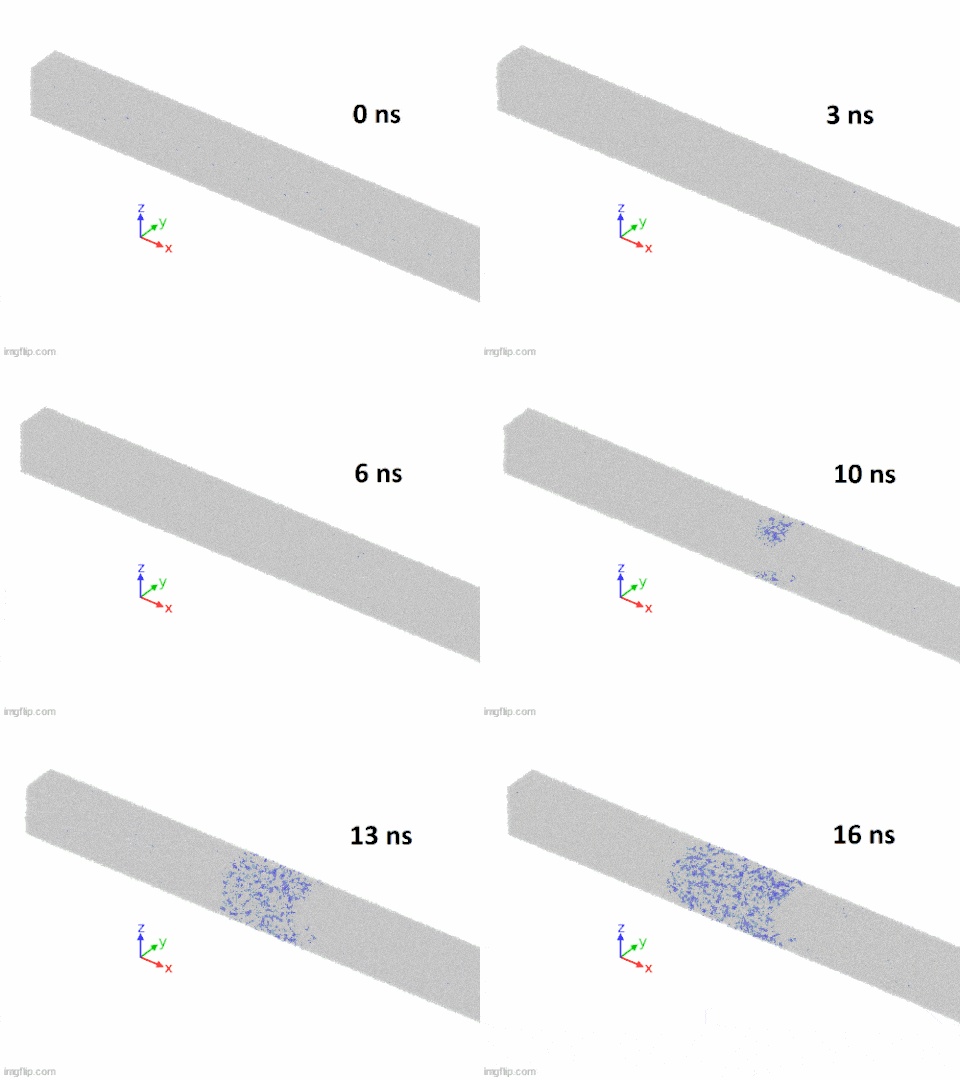
The dynamics are governed by the same two timescales. If the excitation leaves the glass long enough above the glass transition, nuclei form and the material devitrifies, losing precisely the disordered structure that gives a metallic glass its properties. If the quench is fast enough, the amorphous state is preserved even though the material was fully molten.
The control parameter is again the deposited energy and the depth over which it is deposited, and the outcome is again a competition rather than a threshold.
What makes this case instructive alongside silica is the reversal of the goal. In the glass one wants to create and keep a crystal; in the metallic glass one usually wants to avoid creating one, since the amorphous state is the functional one. The physics is the same and only the desirable side of the competition changes, which is a good test of whether the description is genuinely predictive.
The comparison also connects this theme to the microstructural one: in a crystalline alloy the same simulations follow melting and recrystallization, and the quantity to control is the grain size rather than the presence of a crystal at all.
05Where this scale sits in the chain
Upstream, everything rests on the excited electronic structure of the previous theme: the gap that narrows sets how the energy is absorbed, and the electron pressure and coupling set how it is handed to the lattice. Downstream, the crystallized and densified volume is a new optical medium, with a different index and a different damage threshold, which the following pulse will encounter. The nanogratings written for optical data storage live exactly on this feedback.
This is the second rung of the ladder: an order parameter, here the coordination and the short-range order, destroyed and rebuilt, with the final state selected by a competition between a rate of transformation and a rate of relaxation. The same argument returns at the microstructural and surface scales with different quantities.
Key publications
- From pore collapse to crystal growth: ultrafast laser-induced stishovite formation in nanoporous silicaA. Yedigaryan, M. Y. Noor, E. Kachan, G. Calderon, J. Hwang, E. Chowdhury, J.-P. Colombier, submitted (2026)
- Thermodynamic pathways of silica glass densification by molecular dynamics simulationsA. Melkonyan, E. Kachan, J.-P. Colombier, Applied Physics A 131, 615 (2025). doi.org/10.1007/s00339-025-08702-9
- Dynamics of Cu-Zr metallic glass devitrification under ultrafast laser excitation revealed by atomistic modelingD. Iabbaden, J. Amodeo, C. Fusco, F. Garrelie, J.-P. Colombier, Acta Materialia 263, 119487 (2024). doi.org/10.1016/j.actamat.2023.119487
- Molecular dynamics simulation of structural evolution in crystalline and amorphous CuZr alloys upon ultrafast laser irradiationD. Iabbaden, J. Amodeo, C. Fusco, F. Garrelie, J.-P. Colombier, Physical Review Materials 6, 126001 (2022). doi.org/10.1103/PhysRevMaterials.6.126001
- Spontaneous periodic ordering on the surface and in the bulk of dielectrics irradiated by ultrafast laser: a shared electromagnetic originA. Rudenko, J.-P. Colombier, S. Höhm, A. Rosenfeld, J. Krüger, J. Bonse, T. E. Itina, Scientific Reports 7, 12306 (2017). doi.org/10.1038/s41598-017-12502-4

