Teaching · Wave physics
Physics of waves: one equation, four kinds of matter
CiTISE integrated preparatory cycle · Télécom Saint-Étienne
A voltage on a coaxial cable, a pressure fluctuation in air, a transverse pulse on a stretched string and the electromagnetic field in vacuum obey the same equation. The course builds d’Alembert’s equation four times, from four different pieces of local physics, then asks what boundary conditions do to its solutions: standing waves, eigenmodes, resonance, and how much energy a wave actually carries.
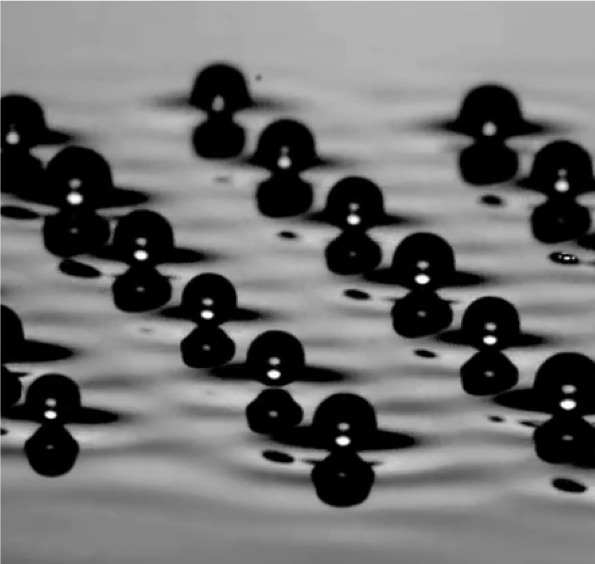
Surface waves on water: the medium oscillates, the pattern travels. Every element stays where it is.
15 h lectures · 15 h problem classes · 3 to 4 h exams · Second year of the CiTISE integrated preparatory cycle, Télécom Saint-Étienne · Course material in French
01What the student takes away
Prerequisites: point mechanics (S1), electrokinetics (S1 and S2), mathematics (S1 and S2). The course is deliberately built so that the same reasoning is repeated on four physical systems until it becomes a reflex.
02Course outline
- Propagation phenomena, with and without a material support
- Definition of a wave phenomenon
- Identification and properties of a wave
- Representation and wave equation
- Electrical propagation in a coaxial cable: the mesoscopic LC cell
- Acoustic waves in fluids: compression and dilatation
- Transverse waves on a vibrating string
- Electromagnetic waves in vacuum
- Boundary conditions
- Eigenmodes and resonances
- Spectral analysis: Fourier decomposition of a vibration, fundamental and harmonics
- Application to musical instruments: how the excitation sets the harmonic content, and what timbre is
- Energy transport by a plane travelling wave
- Maxwell’s equations in vacuum
- Conservation of energy and the Poynting vector
- Behaviour at interfaces
03Lecture material
Four sets of slides, one per part of the outline. Blackboard derivations announced in the slides are done in the lecture room and are not reproduced in the files.
04Problem classes
Five sessions, designed with Elena Kachan. Each one takes the formal result of a lecture and puts a number on it.
The solution space of the wave equation, explored before any physical system is attached to it.
- Travelling wave: f(x−ct) + g(x+ct) as the general solution
- Dispersion relation ω = ck from the complex plane wave
- Standing wave by separation of variables; position of nodes and antinodes
- Radially symmetric spherical wave
- A travelling wave as a sum of two standing waves, and the converse
- Reflection on a fixed obstacle: the π phase shift
Two systems where the celerity is set by material constants rather than by c.
- Longitudinal plane wave in an aluminium rod: celerity from Young’s modulus and density, relative volume change, tension, fixed and free end modes
- Doppler effect for a sound wave
Where the energy of a wave sits, and what a boundary condition does to its spectrum.
- Energy balance of a vibrating string: kinetic and potential densities, flux
- Harmonics of a plucked harp string and the tempered musical scale
The same plane wave treated twice, in vacuum and in a conductor, to show where the difference enters.
- Plane harmonic wave in vacuum: dispersion relation from d’Alembert and from Maxwell
- Propagation in a conducting medium of conductivity γ: transversality is preserved
- Complex dispersion relation k′² = −iμ0γω + ω²/c²
- Structure of a monochromatic plane wave: E, B and the direction of propagation
Polarization states as a basis change, then the first confined geometry of the course.
- Decomposition of a linearly polarized wave into two circular ones
- Circularly polarized waves
- Identification of polarization states
- Propagation between two infinite metallic planes
Note
The slides and problem sheets are written in French, as taught. Problem classes prepared jointly with Elena Kachan.

